Many popular transport policies fail not because of bad intentions, but because complex systems problems are being tackled with linear thinking — focusing on a single, direct path, reckons Russell King. Understanding how a change in one part of a complex system affects all other parts, is the missing mental tool in most people’s education, he says.
 Russell King is a seasoned transport policy strategist with over two decades of experience spanning the UK and Australia. He didn’t begin his career in transport, he told Challenger Cities. He came in sideways, from biochemistry to finance and then to politics.
His career includes having served as an elected London Councillor and as the strategic Policy Advisor to both the NSW Minister for Transport and Infrastructure and the Premier as a senior public servant. His firsthand experience bridging politics, policy, bureaucracy and stakeholders qualifies him to address the systemic barriers to transport reform.
Free subscription to Transport Leader
“Knowing when to apply systems thinking is just as important as knowing how to apply it.
The growing gap between what experts know to be effective policy and what the public will support is, at its core, an education problem. The best time to have introduced systems thinking into our curricula was decades ago. The second-best time is now.
Across the world, governments are implementing policies that are popular with the public yet consistently fail to deliver, and in many cases, actively make things worse.
Rent control, tariffs, energy subsidies, each one a well-intentioned response to a real problem, and each one undermined by consequences that were entirely predictable, if you knew where to look.
Transport is no different. The calls to build more roads to solve congestion, to offer free parking, to make public transport fare-free all enjoy broad public support. And yet the evidence tells a different story. So why do we keep reaching for solutions that do not work?
The easy answer is to blame politicians for chasing votes or the media for oversimplifying complex issues. There is some truth in both. But the deeper problem, I would argue, runs further back, all the way to the classroom.
The way we are taught to think shapes the way we approach problems for the rest of our lives. And right now, we do not spend enough time teaching the right kind of thinking.
Education
The obvious starting point is to ask whether people simply need more education. It is a reasonable hypothesis, after all, if poor policy decisions stem from a lack of understanding, then surely more time in education should help.
And yet the evidence does not support this. We are, by almost every measure, the most educated generation in human history. In many wealthy countries, more than half the population now goes to university.
If higher levels of education were the answer, we would expect to see a meaningful difference in the kinds of policies that educated populations support. But we do not.
Look around, and you will find plenty of university graduates campaigning loudly for more road building, or arguing passionately for free public transport, with little apparent awareness of the unintended consequences either policy tends to produce.
This is not an argument against education. It is an argument for being more precise about what kind of education actually matters. Simply spending more years in formal education does not, by itself, equip people to navigate complex systems.
Something else is missing and to find it, we need to look not at how much we are teaching, but at what we are teaching and, crucially, how.
Subjects
If the problem is not the amount of education we receive, perhaps it lies in the subjects we choose to teach. And here, there is at least some cause for optimism because certain disciplines do seem to help.
Take economics. The vast majority of people with a serious grounding in the subject will tell you, with considerable conviction, that rent controls and tariffs are bad policy.
They understand intuitively (and from the evidence) that intervening in a market in one place will produce ripple effects somewhere else, that you cannot simply cap rents without also affecting the supply of rental properties or impose tariffs without inviting retaliation.
This is second-order thinking, and economics teaches it reasonably well.
The problem is that economic training, for all its strengths, does not travel well across disciplines. Economists who can immediately spot the flaws in rent control will often fail to apply the same logic to a transport problem, such as why building more roads does not reduce congestion; instead, it generates new demand that fills them up, but now with even more congestion. The mental model exists, but it does not seem to transfer.
This tells us something important. The issue is not simply about which subjects we teach, but whether we are teaching people an underlying way of thinking that can be applied across many different domains.
Economics offers a glimpse of that thinking, but it does not go far enough. What we need is something more fundamental, a habit of mind that people can reach for regardless of the problem in front of them.
Systems thinking
If more education is not the answer, and teaching economics alone is not sufficient, then what is? I would argue that there are two closely related things we need to focus on.
The first is systems thinking itself. The second, and just as important, is knowing when to apply it.
Systems thinking is not a new idea. Wikipedia defines it as “a way of making sense of the complexity of the world by looking at it in terms of wholes and relationships rather than by splitting it down into its parts.
In plainer terms, it is the discipline of asking not just what a policy or decision will do directly, but what it will set in motion, the downstream effects, the unintended consequences, the ways in which changing one part of a complex system will inevitably alter others.
The case against rent control is a good illustration. On the surface, capping rents appears to be a straightforward and compassionate response to a housing affordability problem.
But a systems thinker will immediately ask what happens next. The answer, borne out repeatedly by evidence, is that landlords exit the market, the amount of rental properties falls leading, ultimately, to higher rates of homelessness.
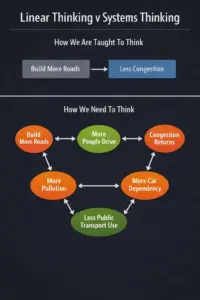
The policy did not fail because of bad intentions; it failed because its designers were thinking in a straight line through a problem that is non-linear.
Transport
Transport is full of equivalent examples. Subsidising car use through free parking, fuel subsidies or toll-free roads means more cars on the road, greater congestion, reduced viability of public transport, increased pollution, poorer public health outcomes and a deeper dependence on oil.
Each of these consequences was foreseeable. Each of them was, in a meaningful sense, the predictable result of linear thinking applied to a systems problem.
Which brings us to the second challenge, knowing when to apply systems thinking in the first place. This is harder than it sounds, because our education system has spent decades training us to think in a linear manner.
Mathematics, computer science, and even introductory economics all tend to reward step-by-step, cause-and-effect reasoning. That kind of thinking is enormously valuable. But it becomes dangerous when applied to complex system problems.
Science education offers occasional glimpses of something different, lessons about the carbon cycle or the water cycle that gesture towards systems, but these tend to teach students about a specific system rather than teaching them how to undertake systems thinking.
The habit of mind does not fully form.
The default
The result is a population that defaults to linear thinking almost automatically, including when faced with policy questions that involve systems. And because that default is so deeply ingrained, it is not enough simply to introduce people to the concept of systems thinking and hope it sticks.
We need to teach them to recognise the kinds of problems that demand it, to develop an instinct for when the straight-line answer is likely to be wrong.
A good place to start is with something almost everyone has experienced firsthand: the school run.
The replacement of walking and cycling with car journeys to school over recent decades is an accessible example of systems dynamics at work that produces outcomes that nobody chose, and few would have wanted.
It is the kind of example that makes systems thinking feel real, rather than abstract.
Curriculum full
Even if the case for teaching systems thinking is compelling, there is a practical objection that cannot be brushed aside: the curriculum is already full.
Barely a week passes without some interest group, think tank or concerned professional arguing that schools should be teaching something new: financial literacy, mental health awareness, coding, climate science, media literacy.
Each proposal usually has genuine merit. And yet the time available to teach anything is finite. Every addition to the curriculum requires either a trade-off against something else or a reduction in the depth at which existing topics are taught.
The curriculum is, in this sense, itself a systems problem, and those who advocate for adding to it without acknowledging what must give, are guilty of exactly the kind of linear thinking this article is arguing against.
So, the question is not simply whether systems thinking is valuable. The question is whether it is valuable enough to displace something else, or whether it can be woven into what is already being taught without sacrificing depth or rigour.
I believe it can, but only if we are honest about what is really at stake.
The deeper argument for making room for systems thinking is not an educational one. It is a political one. Democracy, at its best, is a system for aggregating the informed preferences of citizens into collective decisions.
But that system is under strain. Across many countries, there is a growing gap between what experts believe to be effective policy and what the public is willing to support.
That gap has consequences, not just for transport, but for housing, health, climate and the long-term functioning of democratic institutions.
Jean-Claude Juncker (the former president of the European Commission) captured the problem with characteristic bluntness: “We all know what to do, but we don’t know how to get re-elected once we have done it.”
It is a damning summary of the bind that democratic leaders find themselves in, and it points directly to the need for an electorate trained in systems thinking.
Strong men
There is a harder edge to this argument worth acknowledging. The growing appeal of authoritarian or ‘strongman’ leadership is, I would argue, itself a product of linear thinking.
The logic runs: a strong leader would sort out problems and get things done. It is a seductive idea for many. But follow it through the system, and the questions multiply quickly.
What happens when the strongman makes bad decisions? How is he held to account? How is his successor chosen? The linear solution to democratic dysfunction creates a far more dangerous set of second-order problems than the one it was meant to solve.
If we believe in democracy and in the capacity of ordinary people to govern themselves wisely, then we have to believe in giving them the tools to do so.
Systems thinking is one of those tools. Not the only one, but a foundational one. And that, I would argue, makes it worth finding room for.
Fitting in
Assuming we accept that systems thinking deserves a place in the curriculum, a practical question immediately follows: where does it go? And this turns out to be a harder question than it might first appear.
The honest answer is that systems thinking does not fit neatly into any single subject as it is currently conceived. Examples of complex systems are everywhere across the curriculum in the historical consequences of political decisions, in the geographic dynamics of urban growth, in the ecological interdependencies studied in science and in the feedback loops that underpin mathematical modelling.
In principle, systems thinking could be threaded through all of them. The risk of that approach, however, is dilution. If every subject touches on systems thinking briefly and in passing, the concept never receives the sustained attention it needs to become a genuine habit of mind.
Students may encounter the idea repeatedly without ever developing the depth of understanding required to apply it confidently to an unfamiliar problem. Breadth without depth produces familiarity, not capability.
There is also a coordination problem. If systems thinking is everybody’s responsibility, it can quickly become nobody’s.
Without a clear home in the curriculum, it risks being treated as background context, something mentioned in passing when a relevant example arises, rather than something taught with rigour and intention.
Civics
My view is that the most logical home for systems thinking is civics and, furthermore, that civics should be a compulsory part of every young person’s education.
Teaching systems thinking within civics has a practical advantage: it grounds abstract concepts in the kinds of real-world policy questions that students are likely to encounter as voters and citizens.
Why does building more roads tend to increase rather than reduce congestion? Why does capping rents often lead to housing shortages? Why might a policy that appears to help one group end up harming another? These are live debates that affect people’s lives, and they are far more likely to engage young people than abstract diagrams of feedback loops.
Done well, a civics curriculum built around systems thinking would not just produce better-informed voters. It would produce citizens who are instinctively sceptical of simple solutions to complex problems and who are equipped to ask the questions that politicians and policymakers too rarely have to answer.
Challenges
The challenges facing our transport systems, and indeed many of our public policy challenges more broadly, are not simply the result of bad politicians or an uninformed public. They are the result of a fundamental mismatch between the way we are taught to think and the complexity of the problems we are asked to solve.
Teaching people to think in systems may be the most important civic investment we can make. Our education systems have served us well in many ways, producing generations of people capable of analytical, linear thinking.
But linear thinking alone is not enough when the problems we face are deeply interconnected systems with significant second and third-order effects.
Teaching systems thinking will not be easy. Curriculum time is scarce, and there will always be competing priorities. But if we believe in the value of democracy and in the ability of citizens to make wise choices, then we have a responsibility to give people the tools they need to do so.
The good news is that systems thinking does not need to be a standalone subject taught in isolation. Embedded thoughtfully within civics education and drawing on real-world examples that people already experience, like the school run, it can bring abstract concepts to life in a way that is both accessible and relevant.
The benefits will not be immediate; a curriculum change made today will take years, perhaps decades, to fully work its way through into the quality of public debate and democratic decision-making.
That is, admittedly, a difficult case to make in a political culture that rewards short-term thinking. But if we are serious about leaving the next generation better equipped than we were, there are few investments in our education system with greater potential to deliver lasting returns.”