

A joint venture between Veolia and Ventia, part funded by state government, EarthSure offers thermal treatment and soil washing solutions, backed by shared expertise in waste and water management and specialist remediation across Australasia. The plant can clean up to 160,000 tonnes of contaminated soil per year, equivalent to 25-30 percent of all contaminated soils generated in the state.
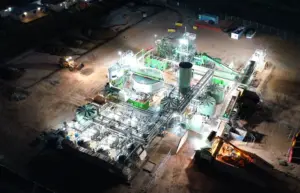
Contaminated (Category C) soils most commonly come from remediation and construction projects. The plant’s advanced treatment processes can be configured to separate organic and inorganic contaminants, including oils, fuel, polycyclic aromatic hydrocarbons, and heavy metals, allowing the cleaned soil to be reused.
Ventia General Manager Environmental Services Adam Fletcher says the facility’s opening was particularly timely as demand for soil washing services increases in support of large-scale infrastructure projects in Victoria.
A scenario which we hope is about to play out in New Zealand through the National Infrastructure Plan pipeline. EarthSure’s facility is a scalable solution for Victoria’s environmental security and circular economy and provides a tried and tested model for transplant to New Zealand.
“The new facility allows us to recover more contaminated soils, by treating them to a level where they can be safely reused in a range of construction and civil engineering applications such as for backfilling, concrete, asphalt, and more,” says Veolia’s Chief Operating Officer Resource Recovery, Carmen Loecherer.
“We’re working to grow our waste, water, and industrial activities across Australia and New Zealand by 10 percent year-on-year, while increasing our energy business tenfold and halving carbon emissions by 2032,” he says
“Healthy soil as a critical resource for the environment and economy. We need facilities that can de-pollute and restore soil to a healthy state, and to stop otherwise useful soil from going to landfill.
“By successfully treating these materials, EarthSure significantly reduces the need for quarried virgin materials. This is a huge boost to Victoria’s sustainability and circular economy targets and shows how businesses like ours play a role in the environmental security of our society.”
The introduction of the soil wash plant complements the existing direct fired thermal desorption facility which already treats more highly contaminated Category A and B waste derived from industrial processes and remediation projects.
Together with the newly opened EarthSure Soil Wash Plant, they establish a trusted, one-stop solution for soil remediation across Category A, B, and C soils.
“As landfill capacity tightens and demand for sustainable construction materials grows, soil washing allows us to keep valuable resources in use rather than buried. It’s a clear example of the circular economy in action — turning waste into supply when the market needs it most,” says Fletcher
“It is a great example of infrastructure designed for the sustainability expectations of today and into the future. ”The plant was established with the support of a $1.15 million grant from Sustainability Victoria Circular Economy Infrastructure Fund — Hazardous Waste, delivered by Sustainability Victoria under the Victorian Government’s circular economy plan.