From extreme weather events to the fuel crisis, cost-of-living pressures and the accelerating impact of AI across industries, global shock waves are forcing New Zealand to shore up its local talent and capabilities. Automation of post-harvest processing of fruit and vegetable packhouses, which is MAF NZ’s specialisation, will increase resilience, says business development manager Chris Bray.
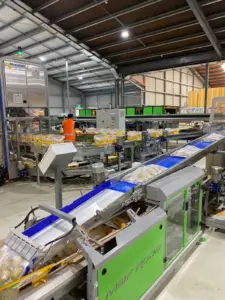
Fast paced horticulture growth is a key national growth plank, and the plan is to double the farmgate value of horticulture by 2035. To achieve this, the horticulture sector is becoming increasingly automated, and the post-harvest period is the key to efficiently and attractively present quality New Zealand produce to the world.
This automated future means the post-harvest workforce needs to rapidly develop new skills. Agritech may not, on the surface, be the first-choice destination for our tech talent, but what we do with our land in the AI era will help determine the future of the New Zealand economy.
What’s surprising is that hi-tech knowledge workers are already trail-blazing in the post-harvest space -where AI-enabled sorting, robotics, IoT, and data-rich packhouses are coming to the for.
Bray recognises the need to play to our strengths. “Building a skilled and sustainable workforce, including investment in post-harvest skills, is a key priority of Horticulture New Zealand’s 2026 election manifesto. New Zealand needs to attract, train and retain more talented people into the niche value-add technology domains that have economy-transforming potential.”
New Zealand clearly has an opportunity to better nurture and retain young talent. There are currently few incentives for companies to grab and train graduates or for graduates to stay and develop in New Zealand.
Half the challenge is to make young talent aware of attractive career pathways they didn’t know existed.
MAF NZ is constantly working with the global head office in France and with packhouses to advance the technology within packhouses for the fresh produce sector. Any new ideas can then be applied to other sectors around the world. Some of the packhouse management software designed in New Zealand is now being used in many other packhouses globally.
New Zealand could be a global test bed for post-harvest-automation. The kiwifruit industry in New Zealand seems to be becoming a blueprint for how to automate packhouses for many industries.
A packhouse in 2035 will have much more advanced camera grading and predictions around how fruit will store/ripen to make sure that customers will have the perfect kiwifruit.
As demand for technology skills continues to grow, the industry is creating new opportunities for graduates to contribute meaningful value to New Zealand’s economy.
MAF machines, for example, are set up so staff can remote into live programmes and clients’ computers to help solve problems. There are exciting challenges in this industry as two recent MAF NZ automations graduates Ben McNabb and Ben Tortoiseshell underscore.
“Being able to help packhouses in Nelson or Auckland from my desk in Tauranga is awesome. I have been wowed by the sheer quantities of produce that are processed in packhouses.”
“I had no idea how large the industry was, so getting a better understanding of how much stress the gear is put through really surprised me.”
“Before any produce packing season, it is mostly testing and debugging newly installed machines. During the season it is mostly fixing breakdowns and solving packhouse issues with gear, whether that be adjusting it to their liking or changing logic to fit their needs.”
“Post-season, it’s lots of programming. Taking electrical drawings and translating them into programme logic. I worked in a packhouse myself during high school as a part-time job. My robotics and embedded systems courses drove me towards automation.”
His fellow graduate agrees.
I turn inert pieces of machinery into functional robots that increase efficiency for packhouses and solve any problems that arise from running them day and night..I worked in a cherry packhouse in my university breaks and had a lot of fun working with many people while getting to tinker with machines.
“Working as an operator gave me an appreciation for this sector. I would have never been aware of the technology used as it is always hidden away in a shed.”
“Automation, computer vision, optimisation and data processing are just a few things you get to work with and make critical decisions around.”
Making a difference and seeing the results ranks highly on the rewards wish list of MAF NZ’s young tech graduates.
“I really like that I am working on physical systems. Being able to write a programme, then download it to a machine, and watch it work is something I really value — versus a general software job where it’s much harder to quantify what you’re doing – and when you improve a section of code, you can watch the machine work faster and with more efficiency. I find that really rewarding.
“Working on new and innovative technology is very rewarding; getting exposed to every aspect of the process means there is always something new to learn. Going from programming non-existent machines for months to seeing it work in real life was my wow moment. It was very rewarding to see my work paying off.”
“I am surprised by how much more responsibility and freedom I am given. My peers in larger companies are often supporting and never getting to make final decisions. I get to make decisions that will be permanent features in packhouses.
“This sector is less advertised, but with amazing job security and every company constantly innovating new tech, there are opportunities for people who want to do R&D, practical roles, software roles and roles that have a mix of all.
New Zealand must build foundations that will drive talent into our hi-tech transformative industries, the graduates say.
“Building a better food and fibre sector reputation and increasing public knowledge around it would provide more interest in working in this industry and get it closer to overseas competitors. It may also help retain graduates in the country.”
MAF NZ recognises that the more Kiwis rely on their own visions, ideas, talent and skills, the better our future standard of living will be. New Zealand will be less dependent on global supply chains, and our place, products and services will be in demand globally.
MAF NZ is a subsidiary of MAF RODA AGROBOTIC, the global leader in the automation of post-harvest processing of fruit and vegetable warehouses with more than 18 locations around the world. MAF NZ specialises in designing, manufacturing and installing the equipment to grade, sort and pack fresh fruit and vegetables.