

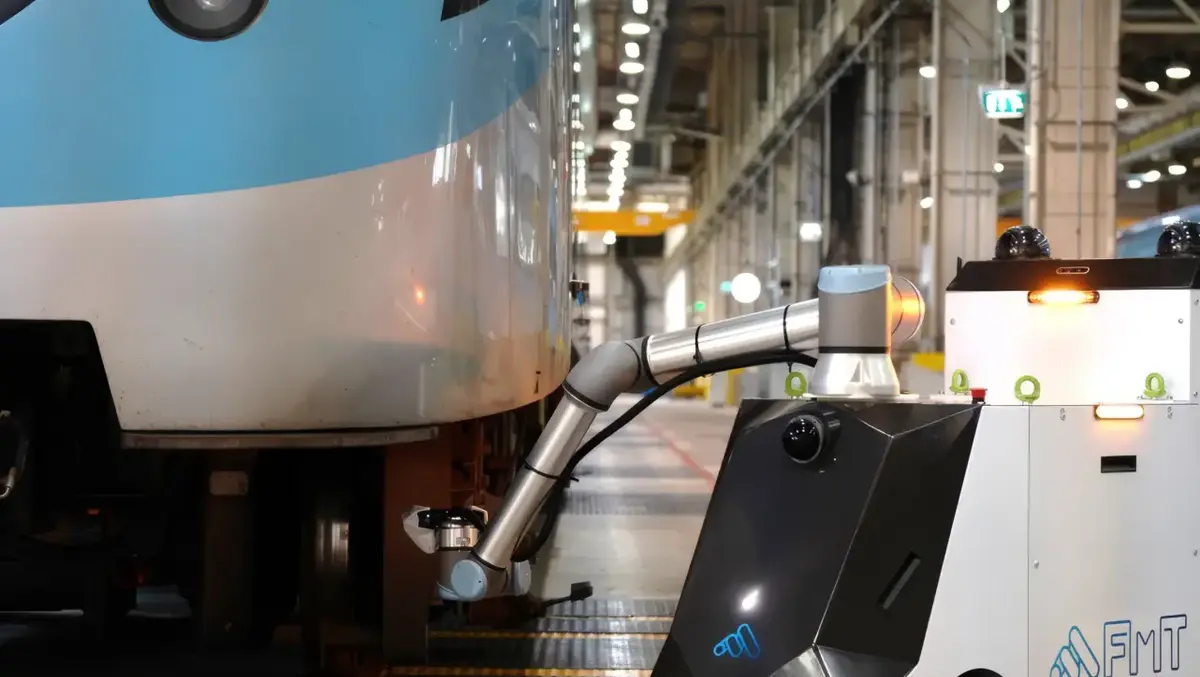
One of Australia and New Zealand’s largest providers of rail and infrastructure services, Downer Group believes the optimal outcomes occur with both humans and robots working side-by-side. It is expanding its long-running partnership with Australian robotics company Future Maintenance Technologies (FMT), backing a practical approach to automation that keeps skilled people at the centre of maintenance operations.
The common narrative around automation is that robots will replace human workers.
But one of Australia and New Zealand’s largest providers of rail and infrastructure services, Downer Group takes a different view – that the optimal outcomes occur with both humans and robots working side-by-side.
Downer has put this theory into practice, expanding its long-running partnership with Australian robotics company Future Maintenance Technologies (FMT). The next phase of the partnership will scale the joint offering across Australia, extend it into new markets, and support expansion into selected overseas jurisdictions.
Downer’s approach is simple: the strongest maintenance outcomes come from combining advanced robotics with experienced technicians, not replacing one with the other. In safety-critical environments, automation works best when it supports people to do their jobs more safely, efficiently and consistently.
XDNA pivot
Through its digital asset management company, XDNA, Downer and FMT are demonstrating how this can be applied in real-world operations.
“We have never believed the version of the automation story that goes ‘robots in, people out’,” Executive General Manager of Downer’s XDNA business, Darren Hungerford, says.
“What really works – what our customers want and what we have proven on the ground with FMT – is robots and humans in harmony.
“The robots take on the jobs that are repetitive, hazardous or simply impossible to do consistently at scale, and our skilled people get to spend their time on the higher-value engineering work that keeps fleets running.”
FMT’s Rail Facility Drones (RFD) and Train Robotic Examination System (TRES) are already operating in live Australian rail environments.
The systems undertake physically demanding inspection tasks such as working under carriages, in confined spaces and at height, while capturing high-quality data that is analysed through AI and reviewed by human experts.
This enables more consistent inspections, richer asset data and earlier fault detection, while reducing the time people spend in hazardous positions. Technicians are able to focus on diagnosis, planning and higher-value engineering work. Safety is built into the design of the technology.
Each platform uses multiple sensors to continuously monitor its surroundings, automatically adjusting speed or stopping when people or objects enter a defined zone. This allows maintenance crews and robots to work side by side without the extensive exclusion zones often required with traditional automation.
FMT connection
Downer was FMT’s first major industry partner, supporting early trials in complex, safety-critical operating environments. Since then, Downer has remained a foundation partner through pilot programs, live deployment and commercial scale-up. The next phase formalises what has already been years of joint problem-solving and customer delivery.
That local foundation is intentional. Downer sees strong local capability and skills as essential to the way new technologies are introduced into Australian infrastructure and as a model that can be adapted for other markets.
With more than 155 years delivering rail services, Downer sees the partnership as closely aligned with its long-term direction.
“We backed FMT early because we could see the tangible benefits for our customers, safer inspections, better data and more effective use of our workforce,” Hungerford says. “This next phase is about taking what we’ve proven together and delivering it for more customers, in more markets.”
FMT Chief Executive Officer, Loic Ayoul, says Downer’s support had played a critical role in the company’s growth.
“Downer gave us the opportunity to demonstrate our technology in a live operational setting at the Pakenham depot,” Ayoul says. “They’ve worked alongside us at every stage, and that partnership has been very valuable in supporting our progress to date.”
For operators, the benefits are clear: reduced time working at height or under isolated trains, improved inspection consistency, shorter maintenance windows and earlier identification of defects through growing datasets and predictive analytics.
“The rail industry has talked about the future of maintenance for a long time,” Hungerford says. “With FMT, we’re delivering it, practically, safely and with our people at the centre.”