Mount Maunganui slip: Full reopening of facilities could cost up to $38m
Tue, 1st Sep 2026
Reducing the risk of slips and rockfall enough to fully reopen facilities at the base of Mauao could cost up to $38 million, a risk assessment has found.
Tauranga City councillors will consider the report tomorrow as they meet to decide the next steps in the organisation's response to the Mount Maunganui landslide tragedy.
It follows an independent review finding the council missed opportunities over 27 years to take actions that could have prevented the deaths of six holidaymakers.
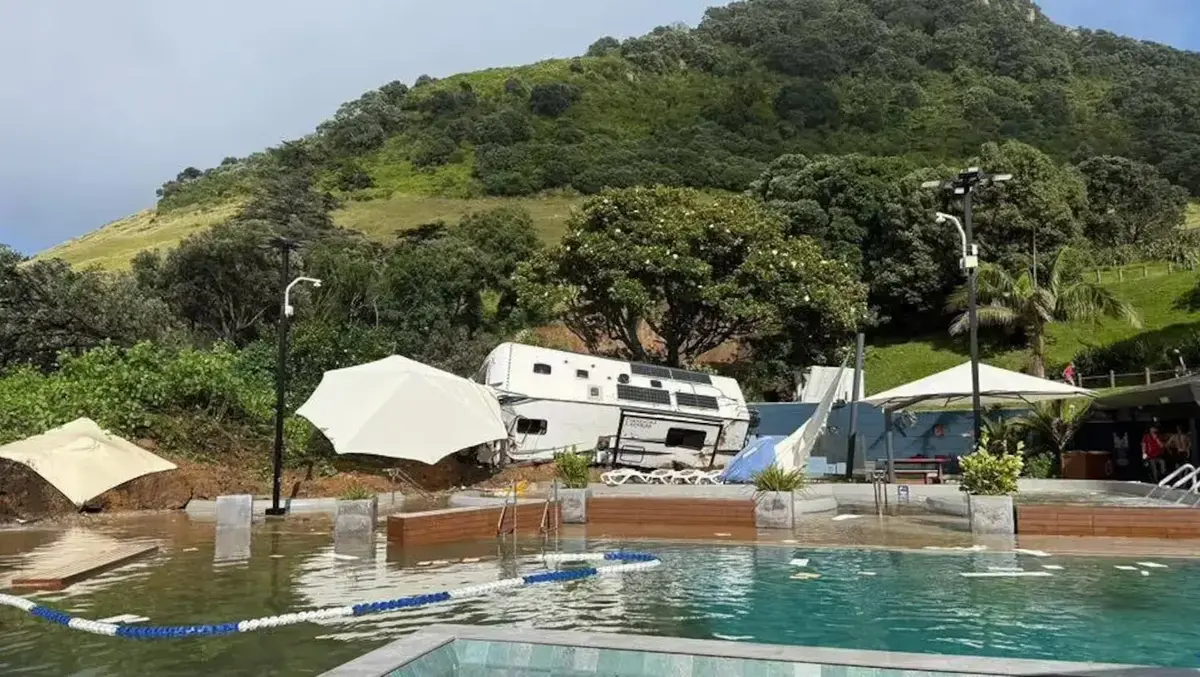
The massive slip crashed down from Mauao into the Mount Maunganui Beachside Holiday Park on January 22, after heavy rain.
Seven months on, the council-owned campground and damaged Mount Hot Pools next door remain closed. As does Mauao, which was hit by 45 slips.
Other Adams Ave facilities, including the Pilot Bay boat ramp and Mount Maunganui Lifeguard Service building, are expected to reopen soon.
The council commissioned a Quantitative Landslide Risk Assessment by Tonkin and Taylor after the landslide.
The report said Mauao was an active landslide environment and landslide and rockfall hazards would continue to affect the base around the holiday park and other facilities.
It concluded the landslide was not an isolated event, but part of a long history of slope instability at Mauao, including 220 slips and rockfalls since 1943.
The report said engineering solutions alone were unlikely to reduce risk sufficiently to meet the proposed tolerance threshold.
Conceptual scenarios estimated restoring full access and use across the holiday park, hot pools and surrounding facilities could require substantial slope stabilisation works costing between $24m and $38m.
Other scenarios involving partial campground reinstatement and restrictions for the hot pools and boat ramp area carried indicative costs of $14m-$18m.
Scenarios involving removing the campground altogether were estimated at $9m-$13m.
The assessment report said the scenarios were not exhaustive and other options, including greater restrictions or retirement of affected areas, remained possible.
Tonkin and Taylor said the final determination of what level of risk was tolerable remained a decision for the council.
Tomorrow's meeting will discuss the Quantitative Landslide Risk Assessment, former High Court judge Paul Davison's review into the tragedy, and recovery progress.
The council has accepted Davison's recommendations.
Staff reports said the recovery, which had so far cost $5.2 million, was moving from a clean-up phase to considering the land's future use.
A report on the QLRA, authorised by council recovery manager Charlie Rahiri, recommended councillors adopt a landslide safety benchmark for future decisions about land around Mauao.
Council staff recommended adopting a risk threshold that aligned with the Bay of Plenty Regional Policy Statement, a previous council landslide risk tolerance decision and international geotechnical guidance.
The report recommended adopting a benchmark of a one-in-10,000-year risk of individual death.
This threshold was described in the report as "a balanced and proportionate approach to risk management". More and less conservative options were not recommended.
The QLRA report said a threshold greater than this was commonly associated with high, significant, intolerable, or unacceptable risk in New Zealand and international guidance.
The report also said the risk to numerous areas exceeded the benchmark – including at the campground, hot pools, boat ramp and nearby pedestrian area, and the Mauao base track.
These would likely need safety measures.
The campground and hot pools were identified as the highest-risk locations because of their proximity to the slopes, high visitor numbers and the vulnerability of people staying for long periods.
If councillors adopted the benchmark, staff proposed the Mauao Recovery Working Group investigate future land-use options, mitigation measures, stakeholder impacts and costs.
The working group will then develop a preferred option or shortlist of options for council consideration.
The group was proposed to include elected member representatives, technical advisers, recovery office representatives, Mauao Trust – which owns Mauao on behalf of the three iwi of Tauranga – and iwi representatives.
In a public statement issued by the largest of those iwi, Ngāi Te Rangi, on Friday, deputy chief executive Roimata Ah Sam said its priority was learning from the tragedy rather than pinning blame.
The iwi believed Mauao should open only when decisions had been made at an iwi level, and Ngāi Te Rangi would "err on the side of caution".
"Where uncertainty remains, the safest decision must prevail."