

Exclusive: Are patchy gov responses to climate change enough?
Thu, 27th Aug 2026
The Climate Change Commission, an independent Crown entity, has this month (August 2026) become the latest agency to slam the government's lack of progress on the national adaptation plan for climate change.
The progress report mirrors its findings of two years ago that the work underway is not enough to make the country resilient to current pressures, let alone into future decades. "The progress made since 2024 has been uneven and serious gaps remain.
"New Zealand is facing serious and far-reaching climate risks that affect homes and infrastructure, the economy, the environment, health and communities, the report says.
"The national adaptation response is still patchy and . . . is not keeping pace with escalating climate risks in New Zealand and, in some cases, is slipping further behind."
The progress report is a high-level view of exposure and vulnerability to selected climate-related hazards across New Zealand. It contains insights about exposure to flooding, landslides and extreme heat, isolation due to coastal flooding, social vulnerability of communities affected by climate-related hazards and affordability and availability of insurance.
The information in this report can support decision-making about New Zealand's adaptation needs, but the Commission has no brief to recommend specific actions to address climate related hazards.
New Zealand is – too often – paying to react and recover after damage occurs, rather than preparing ahead of time. This is becoming increasingly unsustainable as climate risks and impacts continue to grow, the report says.
Past and current planning decisions to allow development in medium to high-risk sites means more of our built environment is at risk from earthquakes, tsunami, sea level rise, eruptions and unpredictable and more frequent severe weather.
IAG New Zealand is the largest general insurer in the country and it estimates the direct costs to central government and insurers from natural hazards including climate change are about NZ$4 billion per year, which has a significant slowing effect on the economy.
New Zealand uncomfortably sits second on Lloyds of London's list of most exposed countries to natural hazards. It estimates the average cost of natural disasters to New Zealand's economy is 0.7 percent of gross domestic product (GDP) per year.
When taken over the past 20 years, noting the impact of the Canterbury and Kaikoura earthquakes, the cost recovering from natural hazards is 4.3 percent of GDP per year and forecast to grow.
Past and current planning decisions to allow development in medium to high-risk sites means more of our built environment is at risk from earthquakes, tsunami, sea level rise, eruptions, and unpredictable and more frequent severe weather, the Commission appraisal says.
"This requires adjustments across the board. Systems that the country relies on will need to change – for instance how water is managed, or how homes are kept safe.
Critically, local responses will need legal and practical support (including funding options) to be able to scale up to match the rising risks.
The Commission's progress report joins a band of government agency reports since Cyclone Gabrielle in early 2023, in many cases initiated by the government itself as a response to public concern, alerting it to the country's lack of investment in preventing the effects of climate change.
Cyclone Gabrielle was a devastating Category 3 severe tropical cyclone that struck the North Island of New Zealand, claiming a dozen lives. It stands as the costliest tropical cyclone in the Southern Hemisphere, racking up around $14.5 billion in damages.
The Climate Commission report also comes hard on the heels of the damning Davison report on the "known risks and completely preventable" landslip disaster at Mt Maunganui in January which took six lives.
It lists 10 systemic recommendations to address decades of risk-management failures including clear accountability, mandatory hazard reporting, and enhanced monitoring for safety threats.
Key proposals focus on creating a central hazard register, implementing Trigger Action Response Plans for site evacuations, and requiring pre-construction geotechnical evaluations.
Closing this gap between research advances and delivering the practical solutions made possible by engineering and government investment was the focus of a landslide conference featuring representatives from four international societies in Queenstown at the end of April.
More than 400 engineers, geologists, scientists, social scientists and communicators spent the best part of a week, hearing the latest research on landslides, learning more about potential solutions, and visiting the landslide-prone locations of Milford Sound and the schist landscapes of Central Otago.
A series of workshops looked at different types of modelling, slope-stability guidance efforts, and appropriate land-use planning to reduce the risk to communities and individuals.
New Zealand's Natural Hazards Commission stated it had now received more landslide-damage claims, mostly caused by storm rainfalls in parts of the North Island and the top of the South Island, than for any other hazard.
In the last five years, the commission received almost 13,000 claims for landslide damage,10,000 more than over the previous five-year period.
Engineers can come up with all sorts of measures for adaptation and mitigation, but responsibility for life and livelihoods starts with government, local councils, planners and the communities themselves, who determine land use and what level of risk they are prepared to accept.
New Zealand's largest active urban landslide is in the Nelson suburb of Tāhunanui. It is a 27-hectare complex rotational slump which gets triggered by heavy rain and has been modelled using Seequent Leapfrog to relate the behaviour of the slide to how it connects with the underlying geology.
Pacific island nations are also highly vulnerable to landslides due to their geology and frequent torrential rainfall. One example comes from New Caledonia, where a 2.2km critical access road through steep terrain was badly damaged by a deep-seated landslide containing about 15,000 cubic metres of material.
Engineering and construction manager Hatch used several pieces of Seequent software – OpenGround, Leapfrog Works, and GeoStudio and PLAXIS – in its remediation work to ensure that in future the route is as robust as it can possibly be.
Community resiliency is a combination of adaption, smart land use, and engineering solutions, but also education and preparedness.
Remote communities can be quite resilient and aware of the risks, but the social mix of communities is also changing evidenced on field trips to places where tourists make up half f the population on any one day.
Beca Associate Engineering Geologist Christoph Kraus says the New Zealand Geotechnical Society and Australian Geomechanics Society are working on several landslide guidance documents, including an update of the existing landslide risk management guidelines, as well as new slope-stability guidance documents.
These guidelines incorporate research and experience from New Zealand, Australia, and various parts of the world to provide well-researched, up-to-date guidance.
In New Zealand we have a Landslide Database, a searchable resource for individuals and those planning and engineering new settlements and subdivisions, looking after key infrastructural assets and assessing emergency management planning.
Earth Sciences New Zealand is upgrading its database, increasing the number of landslides it has classified from 23,000 to more than 500,000. Details such as the trigger for movement, their size, and damage are also being added.
A clear commitment to business leading us out of recession
The numbers of absolute deniers of climate change have all but disappeared in the light of local and global events. New Zealand government enthusiasm for the continued use of fossil fuels has not.
Open support for mining and oil exploration and a recent billion dollar commitment on an LNG terminal to provide back up for the country's renewable energy grid set the scene.
A bill that will stop a climate activist's lawsuit against New Zealand's biggest emitters has just passed its final reading in Parliament. The minister in charge, Paul Goldsmith, said it gives businesses certainty.
The Climate Change Response (Tort Liability) Amendment Bill prevents lawsuits against companies for climate-changing emissions under tort law.
"The law would confirm that the role of implementing policy in respect of greenhouse gas emissions "sits with the elected Government and the Parliament", says the Minister.
The political philosophy appears to be a committed belief it can balance support for business investment while satisfying the local and global demands forced on it by a changing physical environment.
It is in the mandate of the Climate Commission to show the government how to do that, not to act as its conscience.
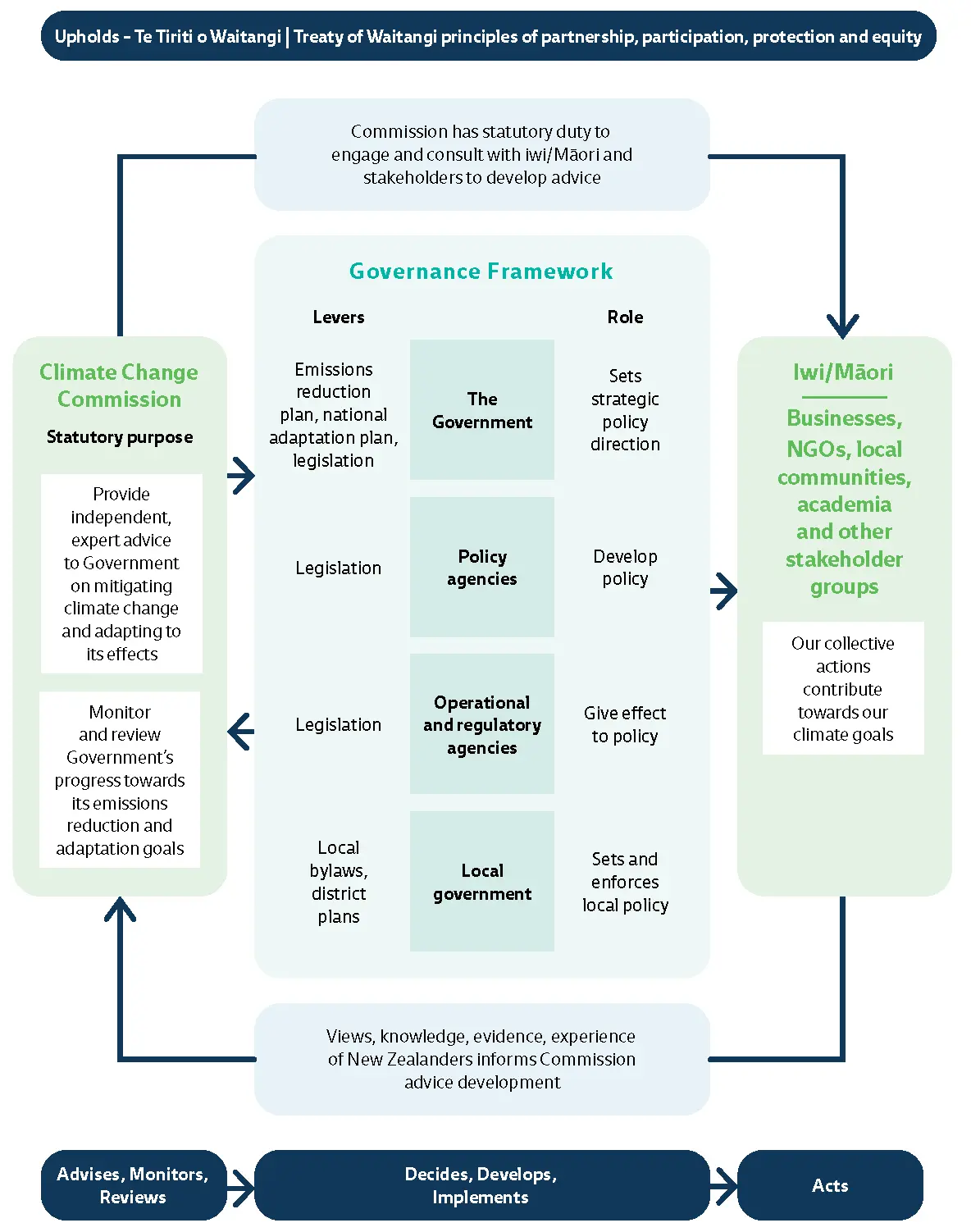
"We are independent from the Government – we don't write climate policy, set targets or regulations, or implement the Government's climate initiatives.
"Our purpose is set out in the Climate Change Response Act 2022 (the Act), which is to provide independent, evidence-based advice to successive governments on mitigating climate change (including through reducing emissions of greenhouse gases) and adapting to the effects of climate change. And to monitor and review progress towards emissions reduction and adaptation.
Our analysis supports the Government to fulfil its roles under the Act, including achieving emissions budgets and the 2050 target, and allowing the people of New Zealand to prepare for, and adapt to, the effects of climate change.
Our impartial advice focuses on the outcomes that can result from government action and policy, and the choices that decision-makers have. It's then over to those decision-makers to choose how they respond.