New Zealand’s infrastructure sector is under pressure to deliver more – more homes, more transport, more resilience – while reducing emissions. Those goals often are assumed to be in competition with each other but, with steel at least, they are not, says Sustainable Steel Council Executive Officer Jeremy Sole. The SSC plans to reduce emissions in buildings by 90 percent come 2050.

Sustainable Steel Council Executive Officer Jeremy Sole
The Sustainable Steel Council’s (SSC) newly launched Forging Ahead roadmap, unveiled at Parliament in April, sets out a practical, sector-led pathway to reduce emissions from steel used in buildings and infrastructure by more than 90 percent by the middle of the century, with a reduction of more than a 30 percent targeted by 2030 – a milestone which SSC says is already on track.
The roadmap reflects more than two years of collaboration across steel’s value chain – from manufacturers, importers and recyclers through to designers, engineers, builders and asset owners.
The core message is clear. Significant emissions reductions are achievable, and the most enduring gains will come from how we design and use steel.
Rick Osborne, Chief Executive of Metals NZ says the roadmap demonstrates how the steel sector is approaching decarbonisation through practical collaboration and innovation rather than trade-offs.
“This roadmap shows that reducing emissions in steel is not about compromising on performance, safety or resilience. It is about applying smarter design, better material efficiency and more circular thinking across the entire value chain,” he says
At the launch of the report, Climate Change Minister Simon Watts acknowledged the sector’s leadership and highlighted the importance of industry-led solutions, alongside the role of government in providing the tools and incentives needed to support continued progress.
Osborne says the steel sector is committed to working alongside government, infrastructure owners, designers and contractors to deliver practical emissions’ reductions while continuing to support the infrastructure and economic growth upon which New Zealand depends.
“That government and industry alignment matters,” reckons Sole. “Because the conversation about decarbonising construction materials has too often focused on what we might have to give up – performance, safety, cost certainty. The reality is different. We can significantly reduce emissions, and we can do it by working smarter.
The question, he says, is not whether we continue to use steel, it is how we use it. “Steel is fundamental to the infrastructure New Zealand depends on every day. It underpins our buildings, bridges, energy systems and transport networks.
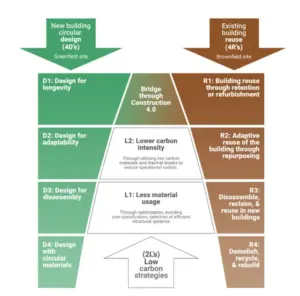
HERA’s Low Carbon Circular Design Hierarchy (ShahMohammadi, et al., 2025a)
Simple solutions
The most immediate opportunity lies in something simple: using steel more efficiently. Across many projects, steel is still routinely over-specified. Designs often include more material than is structurally necessary, driven by conservative assumptions, legacy practices or a lack of early-stage optimisation.
“That comes at a cost – not just financially, but in embodied carbon,” says Sole.
“Better design changes that equation. By optimising structural systems, reducing unnecessary mass and making smarter material choices earlier in the design process, we can deliver the same performance with significantly lower emissions. In many cases, without increasing cost – and sometimes while reducing it.
“This is not about cutting corners. Safety and performance remain non-negotiable. It is about precision and using exactly what is needed.”
Alongside smarter design sits another major opportunity – keeping steel in use for longer.
Steel is uniquely suited to reuse. It can be recovered, repurposed, reconfigured, and building structural elements adaptively reused without losing its structural integrity.
In New Zealand, around 90 percent of steel from demolition is already recovered for recycling. That is a strong foundation but it is only part of the story, says Sole.
“The next step is moving further up the value chain – from recycling to reuse. Extending the life of existing assets by designing buildings for disassembly and enabling structural steel to be reused directly can significantly reduce emissions. Every tonne of steel we do not need to remanufacture is a direct emissions saving.”
Changing methods
At the same time, the way steel is produced is changing by the transition toward electric arc furnace technology. Using recycled scrap steel and powered increasingly by renewable electricity is already underway.
In New Zealand, significant investment in new production capability, including at NZ Steel, is expected to reduce emissions from domestic steelmaking at the Glenbrook operation alone by about 50 percent.
Globally, similar shifts are occurring as the industry moves toward lower-emissions steelmaking and cleaner energy sources.
“These changes are critical, but they take time and capital. “But we do not need to wait for them to deliver meaningful reduction.
“The fastest gains this decade will come from demand-side decisions – how we design, specify and use steel in projects. No single part of the system can deliver the change alone,” says Sole.
“Designers influence material efficiency at the earliest stages. Engineers determine structural performance and optimisation. Contractors shape procurement and construction practices.
“Customers and asset owners set expectations and priorities. Government can accelerate progress through policy settings and procurement signals,” he says.
“What the roadmap makes clear is that a coordinated, whole-of-system approach is essential – one that recognises the interdependencies between design, material choice, construction methods and long-term asset performance.”
“This is particularly important in infrastructure, where decisions made today will lock in emissions for decades.
“A bridge, a hospital or a transport corridor built now will still be in use in 2050 and beyond. Getting those decisions right at the outset is critical.,” says Sole.
Growing recognition
Encouragingly, the direction of travel is becoming clearer. There is growing recognition that embodied carbon must be considered alongside cost, time and performance.
“Tools and methodologies for measuring and managing those emissions are improving. Digital design and modelling technologies are enabling more precise optimisation. And the level of collaboration seen in developing the roadmap reflects a broader shift across the sector, says Sole.
“Better design can reduce costs. Reuse can create new value streams. Efficient material use can improve project outcomes. And lower emissions can strengthen the long-term resilience and credibility of our infrastructure system.
“But progress needs to accelerate. If we are serious about reducing emissions in infrastructure, we need to move beyond incremental change. That means embedding low-carbon thinking into standard practice – not treating it as an optional extra,” Sole says.