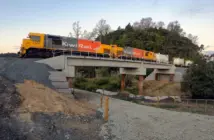
A rail bridge pier collapsed in April on the Main South Line at Rangitata after floodwater scoured away its support. KiwiRail knew Bridge 57 had a scour risk but had not devised a bridge-specific mitigation plan or specific predefined controls. The line remained open until a member of the public on the adjacent road bridge reported the collapse.
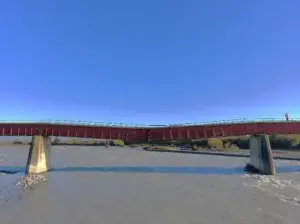
Image credit: TAIC
The riverbed changes were not tracked closely enough to show how serious the scour risk had become according to a report by the Transport Accident Investigation Commission (TAIC). KiwiRail was also aware of the severe weather, but its response relied on general procedures.
Heavy rainfall in the Southern Alps led to high flows in the Rangitata River, scouring away riverbed material that had supported Pier 8 of Bridge 57 on the Main South Line. The pier collapsed, causing major structural damage.
The bridge had been inspected, but the riverbed changes were not tracked closely enough to show how serious the scour risk had become.
Inspection
KiwiRail management had an incomplete understanding of the river’s changing condition because their inspection system was not producing the information they needed to understand the risk. Riverbed profile monitoring was inconsistent because audit processes were not identifying non-compliance with inspection standards.
Asset management
The known scour risk remained insufficiently controlled because risk-ranking tools and asset management system identified risk but didn’t require corresponding controls. So there was no clear trigger to push the issue into operational decision-making.
Weather response
The bridge was left exposed during a red-alert river-flow event. The adverse weather procedures did not define asset-specific thresholds. The rail line remained open after the warning level was reached. The inspection and operating response depended too heavily on historical experience rather than a documented risk basis.
The Commission has recommended that KiwiRail ensure inspections and audit procedures for structural assets fully comply with its quality management system and standards, especially monitoring of riverbed profiles.
In addition, it should develop and document a risk-based asset management and maintenance system for flood and scour risk to rail bridges nationwide.
The report says a review of Trigger Action Response Plans (TARPs) is called for on all high-risk assets so that they contain adequate responses to the weather-related risks specific to each asset.
With complex infrastructure assets, visual inspections alone may not be enough to establish structural integrity and safety and to remain fit for purpose, asset management plans need the key risks identified, then regularly reviewed and updated.
With the increasing frequency of adverse weather event, transport operators and infrastructure owners need to future-proof the safety of operations.
About TAIC
The principal purpose of the Transport Accident Investigation Commission is to determine the circumstances and causes of aviation, marine, and rail accidents and incidents with a view to avoiding similar occurrences in the future, rather than to ascribe blame to any person. TAIC opens an inquiry when it believes the reported circumstances of an accident or incident have — or are likely to have — significant implications for transport safety, or when the inquiry may allow the Commission to make findings or recommendations to improve transport safety