In the US much of the concern surrounding AI is about the technology’s economic power to reshape work and the political power resulting from concentrated wealth, says Stephen Bessasparis . However, the rise of AI also impacts a more literal form of power: electricity, from the data centres that consume it and our ability to weather a supply drought in New Zealand without a billion dollar spend on a fossil fuel terminal.
This article is abridged and adapted for New Zealand conditions by publisher Mike Bishara
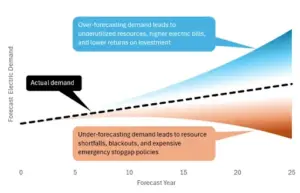
The hazards of over- and under-forecasting load is abridged for New Zealand readers from a US-focused report by Stephen Bessasparis for The Bulletin of the Atomic Scientists
Like their Kiwi counterparts, consumers in the US are worried about rising energy costs and grid reliability around AI. Environmentalists are decrying data centre carbon emissions and a potential increase in the use of LNG back up here in New Zealand.
AI poses a foundational challenge to our electric grid. By understanding the when, where, and how much, people can chart a path towards the best future for themselves, their society, and the world. Humans are not powerless, says Bessasparis.
The electric power industry relies on demand, or load, forecasts to guide investments. Load forecasts predict the amount of electricity required five, 10, or even 25 or 40 years in the future. Why a government with a three-year mandate feels the need to become involved as a partisan participant rather than an overseer and administrator is hard to understand.
Accurate forecasts rather than partisan politics are important because power infrastructure requires years to plan, finance, and construct: about four years for large natural gas power plants, more than 10 years for the average overhead transmission line, and nearly two decades for the most recent nuclear power plant expansion.
For example, to meet the energy needs of 2040, utilities need to begin planning today. Load forecasts are a critical part of those processes and aim to guide industry planners between these twin hazards, avoiding either over-investment or shortfall, and enabling utilities to deliver electricity to consumers safely, cheaply, and reliably.
Public good and private profit
While experts can try to mitigate potential impacts, addressing these concerns comes with its own challenges: They will need estimates of how many data centres will be built, where they will be located, and how much electricity each will demand. Plus how much back up security of supply is needed.by climate dependent utility producers.in New Zealand.
Such information will allow officials to accurately forecast growth and will be key to moving from a reactive to a proactive strategy.
There is no doubt those estimates are difficult to come by but getting them wrong will lead to consequences beyond the data centres and reserves themselves.
Over-forecasting demand can lead to costly overinvestment and additional burdens on ratepayers, while under-forecasting can increase the risk of blackouts.
Multiple sources of uncertainty—gaps in public information, a rapidly changing market environment, and unknown policy futures—complicate forecasters’ attempts to reduce these risks and contribute to forecasting errors.
Despite these challenges, experts and policymakers can still take steps to protect ratepayers, promote information transparency, and plan for the wide range of impacts data centres may have on the grid.
Upfront deposits and safeguards like “take-or-pay” provisions can align the financial risks of data centres with ratepayers.
Experts could also shift from pursuing a single “most likely” data centre and reserve scenario to analysing a wide scope of possible futures to capture “least regrets” solutions and mitigate the most impactful consequences.
Over-forecasting disaster
More than four decades ago, an inaccurate electricity demand forecast led to the largest public bond failure in US history. In July 1983, the Washington Public Power System (WPPS) announced its inability to pay $2.25 billion in outstanding bonds. The bond disaster was, in part, due to the utility company’s inability to predict the future.
Bondholders, including ordinary citizens seeking a haven for retirement funds, saw the value of their investments drop nearly 90 percent immediately afterwards. The utility company did not finalise settlements until a decade later, and the aftershocks shadow conversations on utility planning to this day.
The WPPS bonds were intended to avert an energy disaster. Forecasts published in the late 1960s and early 1970s predicted the US Pacific Northwest would experience serious electricity shortfalls by the 1980s.
Sound familiar?
Their reasoning was not unsound: The region’s electricity demand, as it is in New Zealand, was fed by abundant hydropower and had grown seven percent annually for the previous 20 years.
Forecasters assumed this growth trend would continue and rapidly exceed the available electricity supply.
In response to their forecasted shortfall, the WPPS began constructing five nuclear power plants to ensure it would have sufficient electricity supply to meet their demand. They were financed in part by the municipal bonds.
Unfortunately, the load forecasts driving these investments were inaccurate.
In New Zealand’s case, over-forecasting demand or reserves carries its own hazards. It prompts utilities to undertake costly infrastructure investments with little return or have it forced upon them.
Without sufficient demand, power plants may be abandoned mid-project, power lines to deliver the electricity may go underutilized, and debt financed against future electricity sales may sour if those sales fail to materialise.
Ratepayers can be caught paying for infrastructure that provides little benefit to the public.
Under-forecasting outcomes
Using historic growth trends, even aggressive trends, can be assumed reasonable. Under-forecasting load can lead to infrastructure under-investment, degraded system reliability and, potentially, dangerous blackouts if actual demand exceeds the grid’s ability to deliver electricity. US officials saw these effects in the summer of 2020.
California experienced electricity demand above their planning targets due to unprecedented heat waves across the Western United States. This unforeseen demand, in combination with other factors, prompted grid operators to order utilities to cut off consumers from power on August 14-15. Nearly half a million people lost power.
Least regrets
How then do experts move forward, given the deep uncertainties that plague these forecasting efforts?
First, they should move past thinking in terms of a single “most likely” forecast. The sources of forecasting uncertainty are too strong to identify the “most likely” future with confidence.
Instead, experts should consider a wide range of possible growth futures: some lower, some higher, and some in the middle. Analysing the consequences of these futures can highlight common risks or opportunities that inform “least regrets” solutions.
For example, if seven out of nine scenarios point to a need for a new power plant or extra storage capacity, then it might be a safe bet. If the remaining two futures warn of dire consequences should the expected demand fail to materialise, then the utility can take measures to mitigate those specific risks.
There may still be some hard trade-offs, but officials will be equipped to make more sound decisions after weighing all reasonable options.
Second, experts should align the financial risks borne by data centres or storing fossil fuels with those borne by the utilities that serve them. Data centres can be built or modified far more quickly than power plants or transmission lines.
If a utility builds infrastructure to meet a data centre’s projected demand, only for the data centre to shrink its footprint or cancel the project altogether, the utility and its ratepayers could be stuck paying for that underutilised or abandoned infrastructure while the data centre carries none of the investment risk.
Requiring upfront deposits from data centres has similarities with New Zealand government plans to make the utilities themselves the funders of the Taranaki terminal infrastructure as an insurance policy, but without building the cost into their charges.
It could be a recipe for disaster for ratepayers with little hope of long-term success and, ultimately, a poor outcome for consumers.
In the US, these types of provisions shift the risk burden back towards the data centres, protect ordinary ratepayers and provide greater certainty for infrastructure investment.
This is not the case with the New Zealand model. The billion dollar terminal is added to a more modest but very real demand from data centres, ironically attracted by dominant New Zealand fossil-free power generation.
Lastly, officials should encourage data transparency. Utilities can build their institutional knowledge and credibility by sharing their forecasting results, with as much detail and fidelity as permitted by law and regulation, with the broader community.
Data centre developers and operators can share details about historical development timelines, key challenges, and facility characteristics. Google already releases quarterly efficiency reports for much of its data centre fleet; this is invaluable to understanding how data centre energy needs change throughout the year.
Stephen Bessasparis is a senior consultant at Energy + Environmental Economics (E3), an energy industry consulting firm, Read his full report here.