In a pair of new studies, researchers set out to determine what’s to blame for rising sea levels along hundreds of shorelines. Understanding how greenhouse gas emissions interact with each location’s unique geography, however, remains challenging In nearly half of locations studied, floods that historically occurred just once a century now take place at least once per decade
To protect the more than 680 million people that call these low-lying areas home, planners will need specific information on how much the waters will rise at each site. Understanding how greenhouse gas emissions interact with each location’s unique geography, however, remains challenging.
One of the studies, published in Science Advances, focused on the breadth of humanity’s impacts.
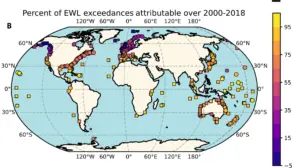
By aligning water level data from tide gauges around the world with models of greenhouse gas emissions, glacial melting and spatial variability, scientists found human-caused global changes had pushed average sea levels to rise in at least 97 percent of the locations they studied and caused more than half of all abnormal coastal high-water events from 2000 to 2018.
The other study, published in Nature Climate Change, used similar methods to examine how climate change has impacted the frequency of the most damaging flooding events. In nearly half of locations studied, floods that historically occurred just once a century now take place at least once per decade. Although not all this flooding is due to climate change (in Manila, for instance, a 300-fold increase in extreme sea level events relates more to groundwater depletion than sea level rise), greenhouse gas emissions are the most common and impactful culprit.
“These results provide robust, observation-based evidence that climate change has already reshaped global coastal flood hazard,” the second study authors wrote. “The transformation is not a distant prospect in future projections by 2050 or 2100, it is underway.”
AsiaPacific Infrastructure will publish a New Zealand targeted sea rise report in July.