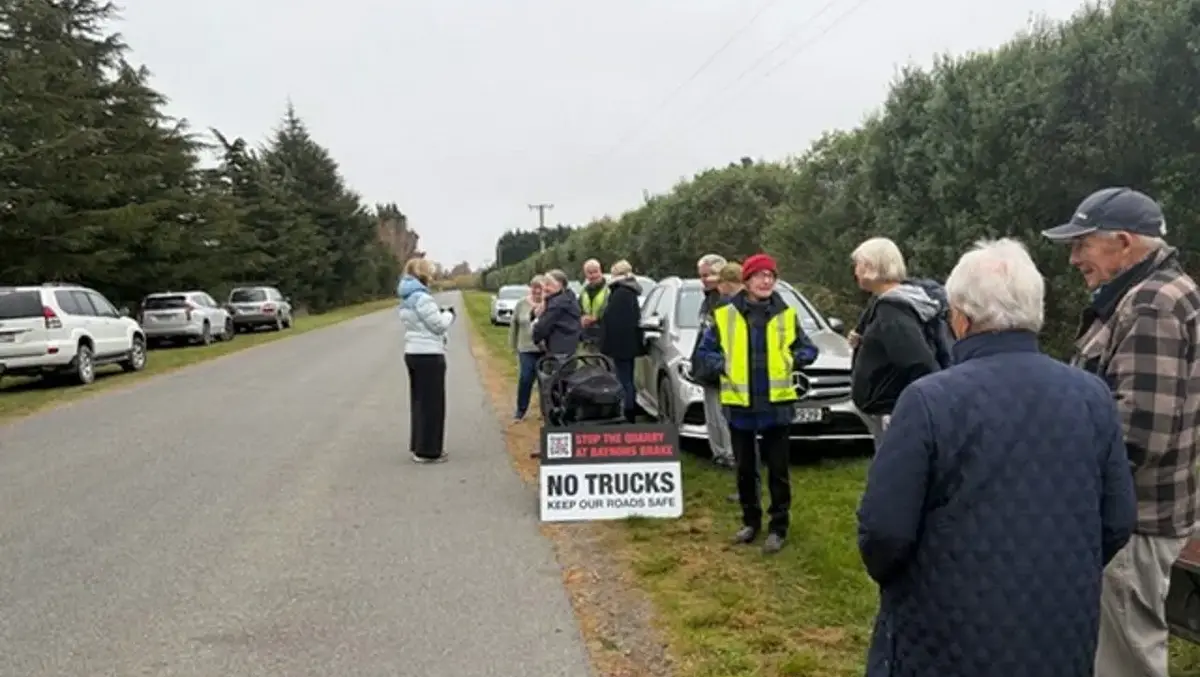
'Tenacity' pays off in community's battle against gravel trucks
Thu, 27th Aug 2026A North Canterbury community says "common sense prevailed" after a new consent agreement will see gravel trucks banned from their residential road.
Residents of Clarkville, near Kaiapoi, have been protesting over heavy trucks pounding their narrow road.
The trucks have been extracting hundreds of thousands of cubic metres of gravel from the Waimakariri River in preparation for the new $1 billion Woodend Bypass motorway.
A new consent issued by Environment Canterbury (ECan) last week required trucks to access the river's north bank via Diversion Road, and banned access via Baynons Road.
Clarkville resident Juliet Edwards said news of the change of route for the new consent is "fantastic".
"Finally we have been listened to. It's just the best news we've had in a long time.
"We think we've had a big win. It's pretty exciting. Finally some common sense has prevailed and people are listening to us."
ECan consent planning manager Henry Winchester said the route was included as a condition after a request from gravel extraction company SOL Screening and Crushing.
Up until now, trucks have been following a route which includes Baynons, Heywards and South Eyre roads at Clarkville, with the majority supplying the initial works for the Woodend Bypass.
But Baynons and Heywards roads are narrow and largely gravel, leaving residents with safety and dust concerns.
Ms Edwards said Waimakariri MP Matt Doocey had been a strong advocate, and residents had met with Waimakariri Mayor Dan Gordon, ECan chairperson Dr Deon Swiggs and senior managers.
Mr Winchester said the new consent allows for the extraction of up to 424,000 cubic metres over a five-year period, including 100,000 cubic metres over the next 12 months.
Traffic management is normally the jurisdiction of the Waimakariri District Council, he said.
Mr Doocey said the "tenacity" of the residents had paid off, after he first met with them in April to hear their concerns.
"It was concerning to hear of the lack of communication and consultation with residents on such an important issue to them, especially when there is a viable alternative route of an established gravel haulage road along the river.
"It is great news to see that their tenacity has paid off and changes have been made to the consents in response to the residents' concerns."
Mr Gordon said he was pleased a positive outcome had been reached.
"I will be writing to ECan as the consent issuer and the contractor thanking them for this inclusion and seeking assurances this will be honoured for not only Baynons Road but also for Heywards Road."
The council established a gravel haulage reference group earlier this year and will continue to monitor the situation, Mr Gordon said.
The gravel extraction sites were chosen by ECan to mitigate flood risk.
Mr Winchester said 12 companies held 17 consents to extract gravel from the river, totalling 3.725 million cubic metres.
Around 1.255 million cubic metres has already been extracted, leaving around 2.47 million cubic metres still to be extracted, subject to consent conditions such as minimum bed levels.
"In areas where gravel has accumulated and raised the river bed, additional extraction may be required to maintain flood capacity," Mr Winchester said.