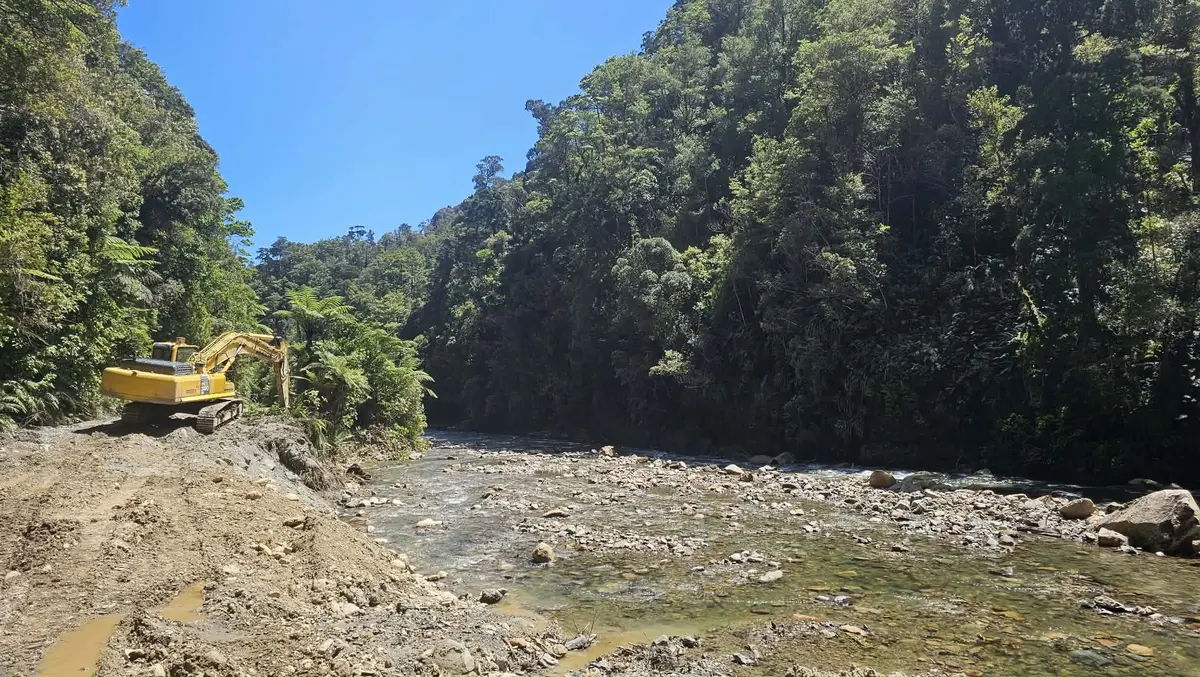
Scenic West Coast valley 'devastated' by excavation works, residents say
Wed, 18th Nov 2026 (Today)Excavation works and extensive vegetation clearance at a West Coast spot known for its rugged natural beauty has left locals questioning the scale and purpose of the activity.
Nearby residents of Ten Mile Valley, just north of Rapahoe, say the landscape they know and love is being transformed, with heavy machinery prompting fears about environmental damage and questions over what work is actually taking place.
"It's an absolute disaster zone -- it's heartbreaking," one Coast Road resident said.
Birchfields Minerals Ltd applied to extract gravel and rock from the historic coalmining valley, which is now a popular walking and swimming spot.
The mining company has applied to the West Coast Regional Council for a 10-year consent to extract up to 5000 cubic metres of gravel and rock a year.
The proposal covers a 930m reach from about 740m above the State Highway 6 bridge.
The recently started works have been met with a passionate reaction from the Coast Road community.
Robert Gamble, a Coast Road resident for 45 years and the closest neighbour to the works, said the area has been "devastated".
"I have a lot of affinity for the area. I realise that economic activity has to go on, but there are limits."
Mr Gamble said the valley was far from an unused wilderness, with people regularly visiting to walk, run and swim, or stopping to take photos of the views.
Ten Mile Creek and the surrounding bush was also home to wildlife, including whio (blue ducks) and eel, while penguins and kiwi lived nearby.
Over the past couple of weeks, he said he had watched a 30-tonne digger working on the riverbank and in the creek itself, alongside what appeared to be mining pump equipment.
Mr Gamble said they were seemingly "gearing up for a big project".
Another Coast Road resident, who declined to be named, said there has been substantial vegetation clearance, rocks and gravel moved around within the creek bed, and "noticeable changes to the natural landscape".
Questions have been raised whether works were simply for quarrying purposes or if gold recovery could be involved.
"When you look at the amount of vegetation that's been cleared and the extent of the disturbance to the creek bed and surrounding area, it's pretty hard to reconcile that with simply replacing a culvert."
The resident said they were not opposed to mining, acknowledging the valley's long history of gold and coal extraction, including suction dredging.
"It's part of the West Coast's history and heritage, and we recognise that. But even the old (underground) coalmining operations didn't leave the surrounding landscape looking like what we've witnessed now."
Local mining historian and regional councillor Peter Ewen also questioned the nature of the work.
Having reviewed the quarry application paperwork, he said he believed it was a "ploy".
"In my opinion, it was a ploy. The application appeared more of a 'put it in, get it ticked -- for no one will know or check' it."
Mr Ewen said the extent of riverbank and vegetation clearance was "severe and unacceptable".
He questioned why so much riverside vegetation and embankment needed to be removed to replace a small culvert.
"Gold fever might be the driver for the rip and blitz destruction at the Ten Mile, with little regard to active plans and environmental safeguards," he said.
"It is bewildering that selfish operators think it is their right to demolish what simply isn't theirs. It is a shared asset that belongs to many for countless reasons."
However, miner Allan Birchfield, who owns the Grey River gold dredge and is also a regional councillor, said mining was not currently taking place.
"We are not mining at the moment."
The work was focused on reopening the private road, improving the safety of access, removing old mining equipment and screening material for road gravel, he said.
The work followed six slips there in the past three months.
Mr Birchfield was unhappy about local criticism and said the area was a mining reserve with no legal public access.
"People should not be there, it is not a safe place -- there is a lot of rock falling."
He said people had refused to leave the site when asked, and equipment had been stolen.
"I'm a bit irate."
Mr Birchfield said the company had the necessary permits.
"We have a right to be there. I will continue as I'm legally entitled to."
Mining had been carried out in the valley for more than 100 years and he dismissed concerns about the environmental effects.
"I have been mining for over 40 years. I know how to run an operation."
The application says the work would be small-scale and intermittent, involving a 30-tonne excavator and a road truck, with no crushing, washing or other processing on site.
Its assessment of environmental effects describes potential adverse effects as "no more than minor".
It acknowledges Ten Mile Valley is within the coastal environment and is identified in the Te Tai o Poutini Plan as an "outstanding natural landscape".
The assessment also acknowledges the creek is listed as sports fish habitat, despite describing fish life as severely limited.
"The flowing channel will not be blocked or diverted, machinery will not be positioned in flowing water, any below water disturbance will be minimised, and work will stop if fish distress, spawning activity or an unacceptable sediment effect is observed."
The West Coast Regional Council has been asked to confirm what resource consents or permits Birchfield Minerals currently holds and whether they are investigating compliance.