Popular Nelson track to be fixed, but it's not expected to last
Wed, 12th Aug 2026
Nelson residents are overjoyed that a popular, storm-damaged Nelson walking track will be repaired, but council staff have warned it will inevitably be damaged again.
The historic Days Track provides a pedestrian link between Rocks Road and Toi Toi Street, creating a direct route over the Tāhunanui Hills between Tāhunanui and Nelson South.
A section of the track, between Moana Avenue and Grenville Terrace, has been closed since an August 2022 storm. The track is prone to damage as it lies on the country's largest active urban landslide.
On Thursday, Nelson City Council agreed to reinstate the track to a basic level amid staff warnings that it was a matter of when, not if, it would be taken out again in a future event.
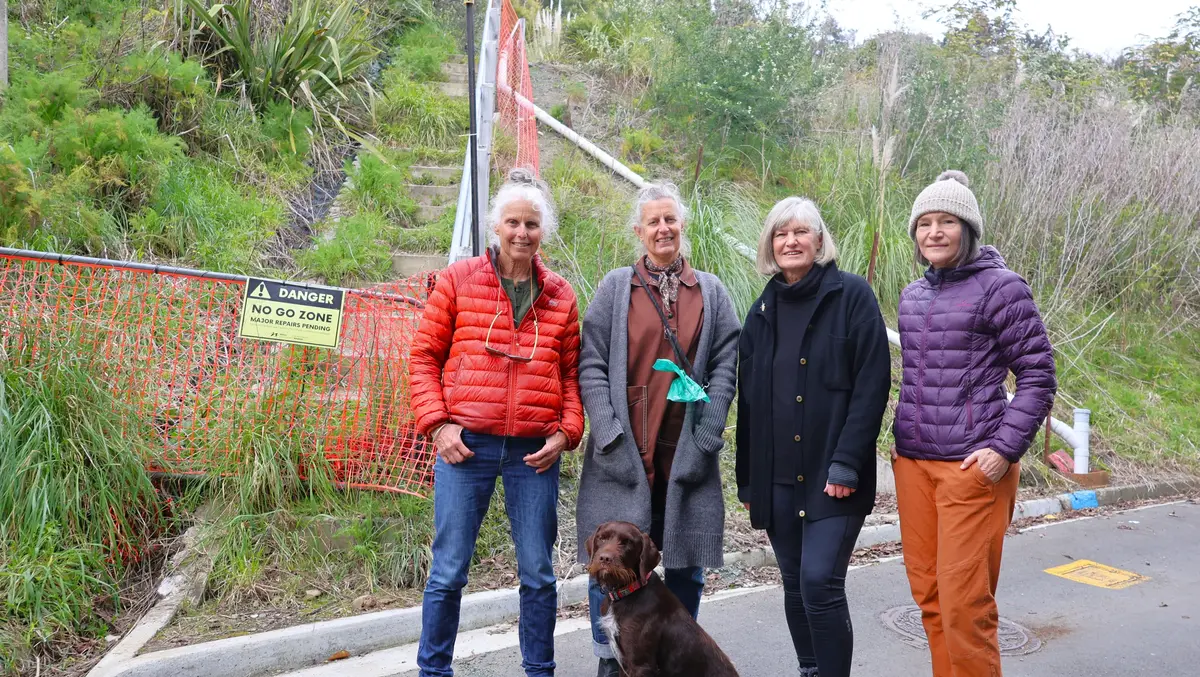
Kelly Atkinson, a member of the Days Track Community Group, had presented to the council before its decision, urging action on its reinstatement.
She told Local Democracy Reporting after the decision that the group was "delighted and relieved" and described the route as "more than a walking track".
"It's part of an essential corridor with infrastructure and significant cultural environmental value," she said.
"It's history, it's connectivity, it just holds a lot of importance."
Atkinson thought the council was right to only pursue a basic rebuild.
"There are engineering solutions, but I think it's the combination of working with engineers and community that will allow us to come up with a good solution that recognises and works with those complexities in a sensible way," she said.
"This is the era in which we live. Repair is inevitable."
The track lies on the Tāhunanui Slump – New Zealand's largest active urban landslide – which executive director delivery Alec Louverdis described as "one of the most complex" geological areas in the country.
"There is no way we could engineer a track that could be built back better and withstand a one-in-100-year event… that's just a physical impossibility," he told the council in its Thursday meeting.
"We will be repairing that track again in the likely event of a storm."
The same section of Days Track was closed following severe weather in 2011 and only re-opened again in 2017 at a cost of $1.1 million.
Reconstructing the track "like for like" would cost $700,000, though that figure included clearing up and replanting the area as well as reinstating some three waters infrastructure that was also damaged in 2022.
But elected members baulked at the price and instead approved "up to" $700,000 of spending with the expectation that only the "minimum standard" would be pursued rather than a total restoration to reduce future reinstatement costs after similar storms.
Mayor Nick Smith, who studied landslides as part of his PhD, said the slip at Days Track was a "nightmare" with no possible permanent engineering solution for the walkway.
"This issue has been going round and round in circles for a couple of years," he said.
He was confident that the council engineering team could design the track in a way that would attempt to mitigate the geological uncertainties and likely future repair bills.
"There are no decisions that council gets to make that have zero risk… and with this one, we may get our fingers burnt with a nasty storm event not long after the work is completed."
Despite the ominous forecast, close to two dozen residents broke into applause once the decision had been confirmed.