

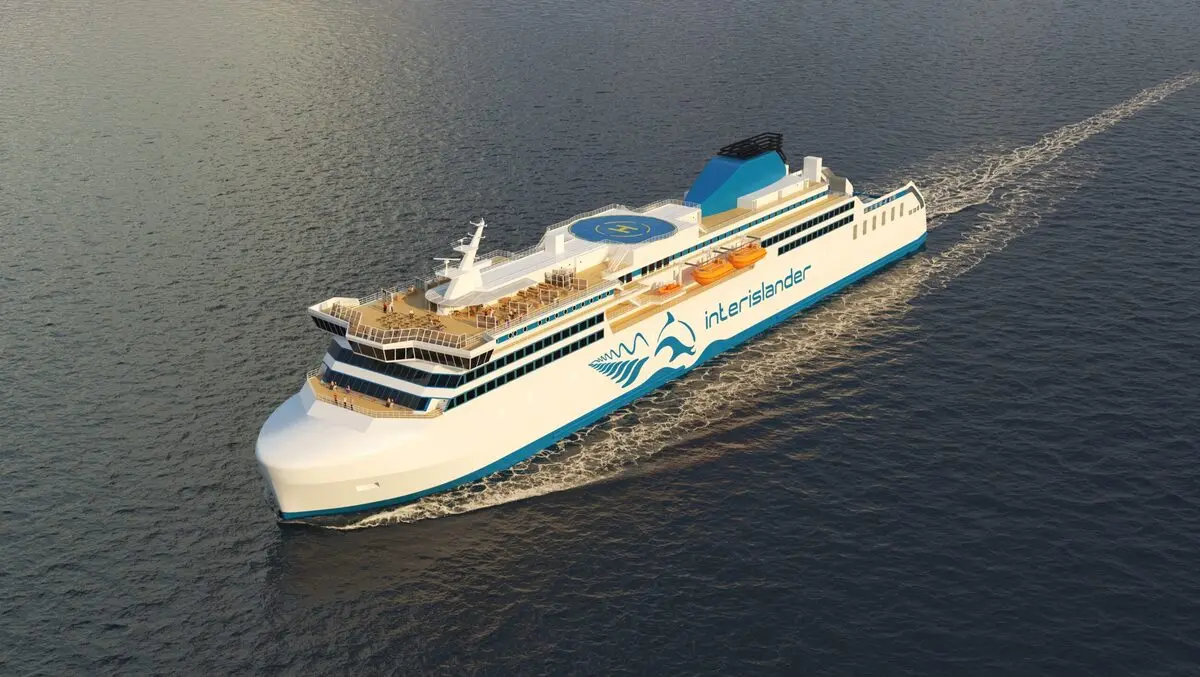
KiwiRail to run new Cook Strait ferries Kupe & Cook
Fri, 17th Jul 2026
New Zealand's Government has confirmed KiwiRail as the operator of two new Cook Strait rail ferries, to be named Kupe and Cook.
The arrangement covers the vessels from their arrival in 2029 across a 30-year asset life, with a review after the first decade. Taxpayer support for the wider programme will remain capped at $1.7 billion.
The decision keeps the Cook Strait service with the state-owned rail operator, which has run Interislander since 1962. Ministers said aligning ferry operations with the rail freight network would support the domestic freight route linking Auckland and Christchurch.
Rail Minister Winston Peters said the decision was based in part on KiwiRail's track record. "KiwiRail has run the Interislander since its inception in 1962, and in our book, experience counts," Peters said.
He said the structure was intended to keep ferry and rail services functioning as a single system. "This decision keeps the rail freight network and ferry operation working as one system, supporting the critical domestic freight route between Auckland and Christchurch.
"KiwiRail has demonstrated improved performance, with Interislander reliability now at 98 percent, and KiwiRail is poised, pending final audit, to achieve its $160 million earnings target to 30 June 2026," Peters said.
Commercial terms
The Government described the operating model as a commercial arrangement rather than a subsidy. Under the plan, KiwiRail will pay port charges to CentrePort, Port Marlborough and Ferry Holdings.
Peters said the financial structure was designed to protect public funding while recognising port investment. "This is no gift. It is a commercial arrangement that protects ratepayers, recognises the investments made by the ports, and ensures taxpayers receive the benefit of every cent invested in infrastructure," he said.
He outlined the payment structure in more detail. "KiwiRail will pay commercially priced port fees to CentrePort, Port Marlborough and Ferry Holdings. CentrePort and Port Marlborough will earn a reasonable return on their $100 million and $110 million contributions respectively.
"Because more complex new infrastructure is being built in Picton, with $373 million to be paid by Ferry Holdings, a special purpose vehicle will be established to co-own assets between Port Marlborough and Ferry Holdings," Peters said.
The programme includes modified marine infrastructure in Wellington and new marine infrastructure in Picton. The contracting approach includes contingency funding and incentives intended to keep delivery on schedule and within budget.
Project reset
Ministers presented the new ferry programme as a cheaper alternative to the earlier iReX project. The Government said the current plan would save New Zealanders $2.3 billion compared with the previous scheme, whose expected cost had risen sharply.
Peters contrasted the new plan with the abandoned proposal. "The new ferry programme saves New Zealanders $2.3 billion compared to the previous project, while still delivering the rail ferries and infrastructure New Zealand needs," he said.
He also referred to cost estimates attached to the earlier project. "Project iReX had blown out to $3.1 billion according to KiwiRail, while Treasury had already warned the previous Government it was on course to $4 billion.
"Our approach is simple: build what is needed, not what is desired. Do what works, not what dazzles. Trust the experts, not the yes-men.
"The ferries will be supported by new marine infrastructure in Picton and modified marine infrastructure in Wellington, funded with appropriate contingency and incentives to keep Ferry Holdings, KiwiRail, both ports and their builders focused on on-time, on-budget delivery.
"There will be no cost-plus construction contracts and no lazy project management. Ferry Holdings holds the purse strings and retains the major rights in controlling the programme," Peters said.
The Government has previously confirmed a fixed-price shipbuilding contract with Guangzhou Shipyard International. It said construction remains on track to begin in 2027, ahead of the vessels entering service in 2029.
Names chosen
The ferries have now been legally registered as Kupe and Cook. Peters said the names were chosen to reflect the country's maritime history and the role of the Cook Strait link in connecting the North and South islands.
"The first ferry will be called Kupe, and the second ferry will be called Cook," Peters said.
He added: "These are proper names. Historic names. New Zealand names.
"Kupe and Cook reflect New Zealand as it actually is: a country shaped by the sea, by settlement, by risk, by enterprise, and by people who crossed dangerous waters in search of a future," Peters said.
Long-term route
Beyond replacing the current vessels, the programme is intended to maintain the rail link across Cook Strait and create a funding path for future replacements. The model would allow KiwiRail to build a reserve for another renewal cycle in 2059.
Peters described the project as a multi-decade transport decision. "This is not just a deal to secure the Strait for another generation; it secures it for the next two generations.
"Once again, we are charting the practical course on new tides, with new vessels, and with common sense back at the helm," he said.