

Exclusive: Auckland's long-term traffic infrastructure starts to take shape
Mon, 16th Nov 2026 (Today)
If Auckland is to become a liveable world city of significance it is not going to be by locking in a somewhat narrow measure of success or failure of Auckland's City Rail link, formed from its first few months in operation.
The success of City Rail Link was always a given unless Auckland was to defy the performance of every other underground rail system in the world. I was working in Hong Kong in 1979 when the then city state opened, with enormous government self-praise and fanfare, the first link in its Mass Transit Railway (MTR) system. The public could not have cared less.
They were grateful for anything that eased the gridlock on the roads (hands up Aucklanders) and almost immediately absorbed the MTR into their commute. And, unsurprisingly, that's what has happened here in Auckland despite the doomsayers and the hand wringing about the cost.
Aucklanders deserves CRL. The city could not afford, not to have it.
New record in the first week
The new network got more than half a million train boardings in its opening week surpassing a 2019 record. The network handled a million trips in its first two weeks and hit two million trips within its first month
Daily boardings have topped out at a bit over 85,000 on weekdays, with overall network usage averaging 75,000 a day. Weekday boardings at downtown stations like Te Waihorotiu and Karanga-a-Hape surged with nearly 6000 daily trips made just between city-centre stations.
City Rail had a good headstart by immediately doubling to 370,000 the number of the Queen City's population of around 1.5 million (not including that north of the Auckland Harbour bridge) who can now access the CBD within 30-minutes although, like Hong Kong, there is not yet a noticeable reduction in the traffic on the clogged motorways.
Traffic and other benefits yet to come
The current Jaffa mindset still sees any freeing up of traffic flow as an opportunity rather than a benefit. That, in itself, deserves further educational commitment to getting people out of their cars and in to public transport.
Auckland has started well on solving the issue - parking in the central city on a regular basis requires a second mortgage to maintain.
Productivity, the environment, property development and retail business have embraced the CRL opportunity, with additional rewards for longer-sighted private investors and developers who had land-banked around stations from Pukekohe in the south to Swanson and Westgate in the west.
Auckland regains a city centre of which it can be proud
A sea change in the face of the city is underway and the icing on the cake is the inevitable revival of a vital city centre of prestige offices, branded retail commerce, entertainment and education, complete with a growing resident population, encouraged by the current glut of inner-city apartments.
The reverse bonus for city dwellers is to live safely in the fashionable centre of the action but use the City Rail link to quickly reach their suburban family and friends and or get to jobs in the outlying suburbs. No car and no need for one.
That's what a truly liveable world class city is all about.
So, what now are the right questions?
No great secret. First is to tie down a schedule (yet again) for an airport connection - that comes first and, arguably, should have come before CRL.
There is currently no active government project or funded construction for a heavy or light rail line connecting CRL directly to Auckland Airport
What aspiring liveable city does not have a link from its airport to a rail network?.
Kiwis need to recognise the region as the engine room for the New Zealand economy and the major service centre (ports) for agricultural exports and tourism. We need to invest what we need to and make sure it works properly.
Unfortunately, large-scale Auckland light rail and harbour tunnel plans are no longer a primary focus of the Labour Party and the National Party has made it clear that its priorities lie with road solutions and inner-city road transit corridors.
An unfortunate history
The saga behind this infrastructure failure being put into the "too hard" basket began after the 2017 general election when a newly elected Labour coalition made a commitment to a light rail project connecting the Central Business District (CBD) to Auckland Airport.
The next 10 years records near farcical tales of a seemingly simple objective being plagued by differing ideas of what was needed and what was affordable, scope creep and Nimbyism before being forced on to the backburner by the arrival of Covid.
Scope creep referred to plans to add a number of extra stops on the route for "maximum utilisation" which would have slowed journey times from the airport to the CBD considerably, destroying its raison d'etre.
"Basically it's trying to be too many things at once and coming up short on all of them," a commentator said at the time.
Heavy or light rail modes
Two options were studied by the New Zealand Ministry of Transport.
Heavy (metro) rail describes the national mainline or suburban rail network such as Auckland Transport's metro-style commuter trains.
The steel rails are heavier and built into a robust track foundation to withstand immense wheel loads and high-speed stresses. The heavy rail option would have allowed a journey time of 39 minutes to or from the airport to the CBD every 10 minutes.
Industry commentators at the time estimated that any decision to use the "light metro combination" would increase costs to more than $20 billion with a new design and a construction period of 8-10 years.
Best laid plans …
At the beginning of 2022, then Transport Minister Michael Wood announced government approval for a NZ$14.6 billion project to establish a partially tunnelled light-rail network and, in October the same year, Auckland Light Rail Limited was established to further work on the project.
It featured an underground line between the city centre and Mount Roskill, which would then emerge to the surface and continue to the airport via Māngere.
But that was not meant to be either -- and in 2023 immediately following the elections, the new government signalled that the project would be cancelled altogether.
The government confirmed it would be spending limited infrastructure funding on its long-held belief in Roads of National Significance and the completion of City Rail Link which it had begun in an earlier incarnation..
Futile efforts -- economical with the truth
Auckland mayor Wayne Brown's refused to lie down and accept the ruling without a fight. He said the project could be built at a fraction of the cost of previous options, citing overseas projects such as the light-rail network in the French city of Angers which cost just $53 million per kilometre, against the $375 million per kilometre which he described as being the current cheapest option for the route.
The plea fell on deaf ears and the coalition government officially cancelled Auckland Light Rail project as part of its 100-day plan, instructing Auckland Light Rail Limited to immediately cease work and begin winding down the company.
The government maintained that over six years, more than NZ$228 million was spent and claimed official advice projected that costs could have ballooned up to NZ$29.2 billion.
Prime Minister Christopher Luxon called it "a wasteful and unfit for purpose project which never delivered one metre of track in six years."
The business case for the cancelled project was finally released in February 2024, showing that every dollar invested would have brought an economic benefit of $2.40.
Opportunity lost to three-year election cycle mentality
By the time that argument is over, rail's golden triangle of Auckland, Hamilton and Tauranga, supported by a hydrogen highway for regional trucking, will be complete.
So too will upgrades northwards to road and rail line and tunnels, reaching Marsden Point and Whangarei.
The upper North Island regions (Northland, Auckland, Waikato, and Bay of Plenty) is expected to account for about two-thirds of New Zealand's total population by mid-century.
It will have an up-to-the-minute rail and road network, sadly unattached to Auckland International Airport.
So where is the discussion between Auckland City Council and the government today on a compromise between no link and a need for speed?
Planners across the ditch leave us in their wake. The newly opened West Sydney airport, for example, is 53 km from downtown Sydney and will have passengers at the doorstep of the Opera House in less than a hour once completed late next year.
In the meantime, it is offering a free bus ride every 15 minutes to St Mary's station, a station on Sydney's City Rail link.
The second question and a tunnel to success
Solving the next issue will probably take a second harbour crossing in Auckland before it can kick off, but the inevitability of rail facilities in any new cross harbour tunnel already has government planners working on the spur line options to reach the booming growth areas in the north.
It is not rocket science to get a headstart and plot a path to Orewa in the north using the existing land adjacent to existing busway and stations - the road highway to Warkworth is already there and to Wellsford probably as well by the end of the decade.
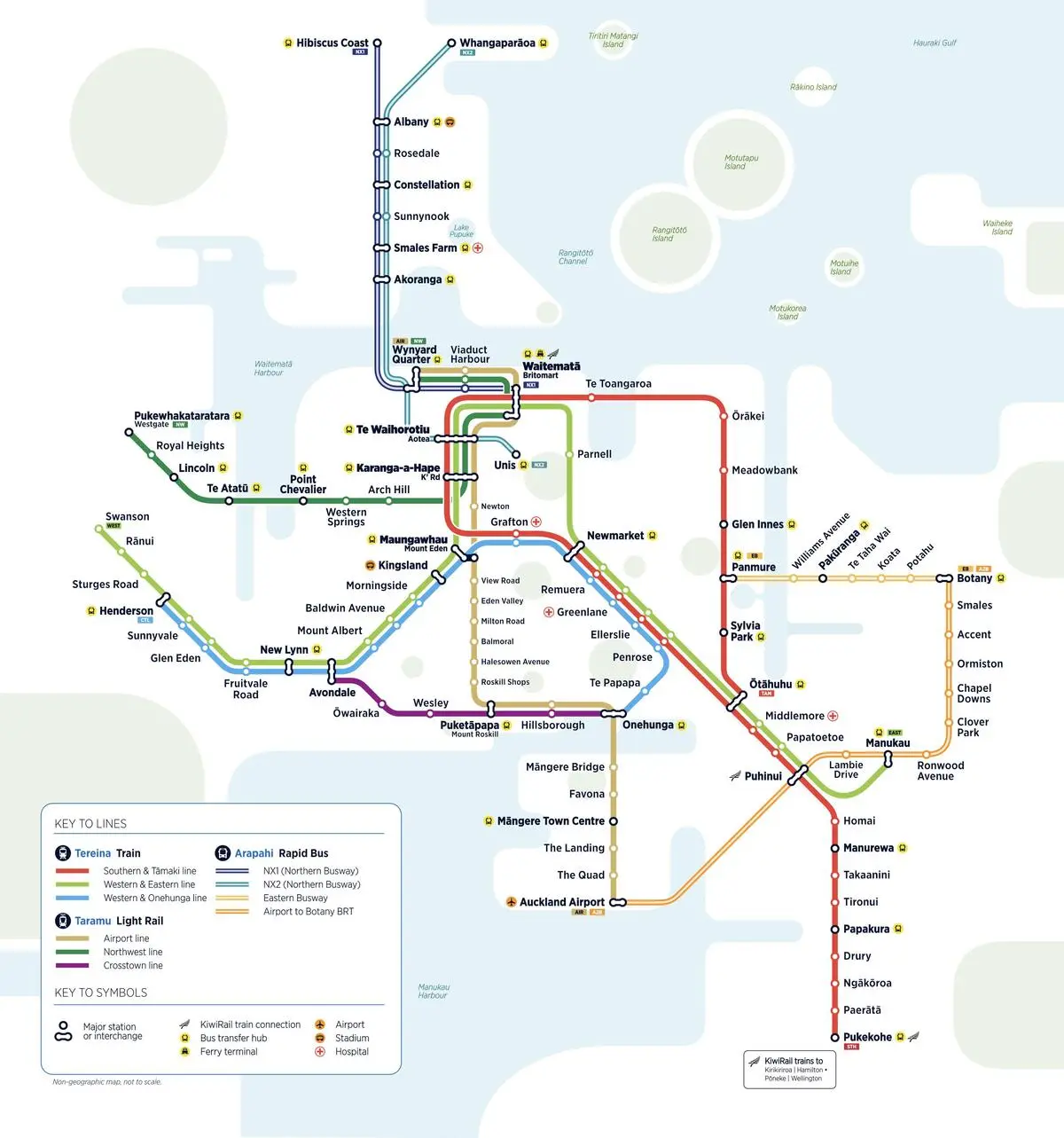
Under the overarching Auckland Rapid Transit master strategy, the ultimate vision extends the North Shore line past Albany, using the Northern Busway's secured footprint as a baseline to eventually reach Hibiscus Coast and Ōrewa.
This rail/light-rail extension is the future-proofing replacement for the current Northern Busway which is expected to hit total capacity within the next 10-15 years
An investment case was endorsed by the NZTA in May this year and the project is now Crown-led, looking at funding models (including potential user tolling) to lock down final alignments.