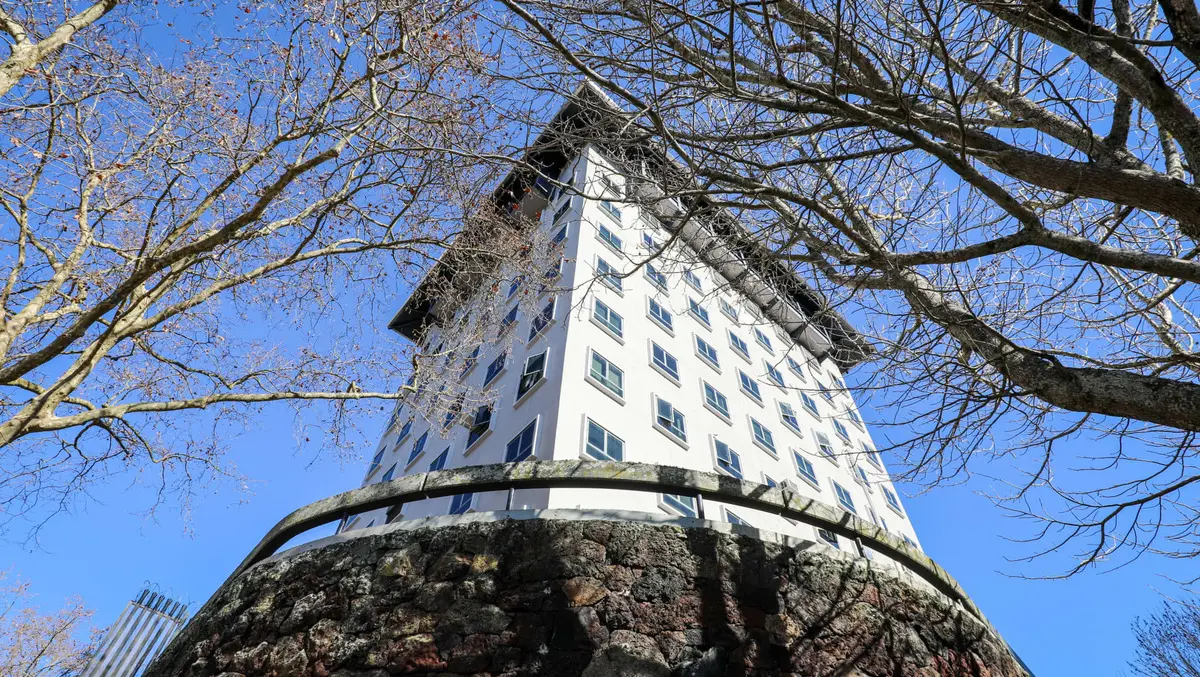
Empty police station should become inner-city high school, advocate says
Thu, 13th Aug 2026
An urban design advocate says a long empty police station in Auckland's city centre could be the perfect home for a school.
At 4580 square metres, the former Vincent Street police station is hard to miss.
Since police left the building in 2019, the pillar of justice has deteriorated into a monument to Auckland's economic slump.
For seven years, the building has stood empty while police funneled upwards of $230,000 a year into Auckland Council's rates bucket.
Since taking it to market in 2024, the Crown and real estate agency Bayleys have struggled to secure a buyer.
Patrick Reynolds, director of advocacy group Greater Auckland, saw an opportunity.
As more families moved into apartments, he said they were discovering a glaring flaw in the city centre lifestyle.
"One of the things that is absolutely a glaring deficiency in the city centre is a high school," he said.
"Families are living in the city centre and there's no school. It seems to be extremely difficult to get the Ministry of Education to contemplate an urban school."
For a family living on Hobson Street, running alongside the Sky Tower, the nearest schools were Auckland Girl's Grammar and Freeman's Bay Primary.
Both were on the other side of Auckland's tangled motorway, which Reynolds said was a great divide.
"There's a lot of apartments on Hobson Street and Nelson Street. In fact, there are more people living on Hobson Street than any other street in the country," he said.
"You see families crossing over to get to that school and it's horrifying, really, because there's a motorway on-ramp there. We really need some schools in the city centre proper."
Patrick Reynolds ran for council under City Vision at last year's election, but was foiled by incumbent Mike Lee.
Lee's vision was more old school than a new school.
"The best possible use, I would think, is for what it was designed for, a police station for central Auckland," he said.
"Better than just leaving the damn thing empty, as it has been."
He was doubtful that enough families were living in the city centre to justify its own school.
"Families and high-rise apartment towers don't necessarily go together," Lee said.
"Families prefer to live on level sections with a bit of a garden for kids to go and play in. If there is, though, a genuine demonstrated need, then that may be a different matter."
Antony Phillips, chair of the City Centre Residents Group, agreed many families would prefer a house over an apartment, buy that wasn't always an option.
"It is starting to become a reality. We see a lot of families who choose to live in the city centre," he explained.
"The idea of raising a family in an apartment building is a long tradition and an expected reality of those living in Paris, London, New York, I could go on."
Phillips said he would prefer a primary school over a high school, but either would be welcomed by residents.
"The city centre residential population has roughly two to three thousand school-age individuals and all of them have to go outside of the community for education and schooling," Phillips said.
"The city centre is a walking community. More than two-thirds of the community do not have ready access to a private motor vehicle."
The Ministry of Education's director of education for central and east Auckland, Jason Swann, didn't rule it out.
But he said the need wasn't there just yet.
"We do not currently have plans to establish a new urban primary or secondary school in central Auckland," he said in a written statement to RNZ.
"However, we expect continued population growth and urban intensification in the area over the next decade, and our analysis has identified that there may be a need for a new state primary school in the future."
A police spokesperson said the property had already been shopped around within the government before it was put on the market, as part of the right of first refusal process.
They said that process could start again if an offer was made below the valuation.