Three authoritative reports over the past couple of years make a pretty convincing case for the economy, efficiency and environmental benefits of rail freight supported by regional hubs for local road delivery, especially in the upper half the North Island. Passenger rail in Wellington and Auckland also get the big tick, says publisher Mike Bishara.
The government appears hoist by its own petard, vociferously backing expensive national highway programmes options. Powerful long-haul associations opposed the use of the National Land Transport Fund to fund KiwiRail which, ironically, is a government entity owned by the people of New Zealand.
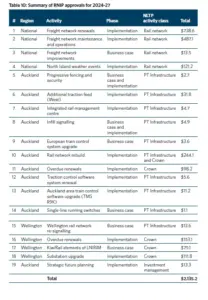
Board member Rob Jager was appointed Acting Chair, KiwiRail after Finance Minister Nicola Willis warned last year that a “board refresh” was coming and an exodus of directors followed. KiwiRail’s current Rail Network Improvement Programme (RNIP) fell into Jager’s brief term at the helm. It is grim reading.
The investment focus for rail is to invest in the busiest and most productive parts of the existing rail network, as mandated by the government, he wrote.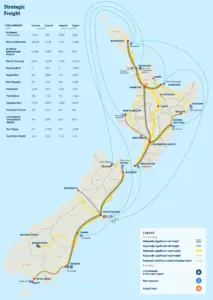 “This document [RNIP] takes account of government objectives, with targeted investment in the metros and Golden Triangle as priority routes of the network,” he said.
“The RNIP has improved KiwiRail’s asset management maturity, knowledge of asset condition and informed our intervention strategies. The remaining task ahead of us however is large, which, combined with a disciplined fiscal approach, means that it will still take us some years to restore a fully resilient and reliable national rail network.
“To reduce funding requirements, we have deferred a significant number of renewal works over the next two years. This is not the preferred and lowest whole-of-life cost option with increased maintenance requirements,” he said.
“These assets still need renewing in future RNIPs and with escalation will cost more to deliver. Similarly, we have not built in high contingency across the 10-year programme and our focus will remain on continued prioritisation of work to ensure we get best value for money.
“The focus of this RNIP will be on maintaining reliability in our most critical routes, and on the safety and compliance of the remaining network.”
Sue Tindal was appointed Chair of KiwiRail and the New Zealand Railways Corporation, and Jeff Kendrew appointed as Deputy Chair. Their terms commenced on 1 July last year.
“Ms Tindal has been a Chief Executive, Chief Financial Officer and Chief Operating Officer and was on the Mainfreight and New Zealand Post boards,” says Minister for Rail Winston Peters. He says appointments to the KiwiRail board bring commercial, freight and rail experience and a ‘can do’ attitude.
“KiwiRail must deliver the goods, so it is pleasing the former acting chair Mr Jager and chair of the risk, audit and assurance committee Mr Wattie finished by signing off on the year-end operating surplus which exceeded their $110 million target,” Peters says.
 “When the taxpayer builds an asset like railways, we expect it to be made use of and not left to waste on the side of the road and that is why we are driving strong focus on turning KiwiRail into the successful business New Zealanders expect it to be,” Peters says.
Tindal expressed concern not long into the job when Scott O’Donnell joined the Board on 1 September 2025. He is also a director of the transport company HW Richardson (HWR) Group and was previously managing director of the Group from 2006 to 2015.
The Group owns 46 companies, employing 2000 people across six sectors including road freight. KiwiRail’s chair questioned the extensive conflicts of a newly-appointed board member, suggesting they would test his loyalty, documents obtained by RNZ show.
O’Donnell is also one of four directors of Dynes Transport Tapanui, which donated $20,000 to NZ First in July 2024. NZ First party leader Winston Peters said the donation played no part in O’Donnell’s appointment.
There are plans in play for established and new strategic rail hubs in Auckland, Hamilton and Tauranga to support the golden triangle which accounts for more than 50 percent of New Zealand’s population and about the same percentage of the country’s economic activity and GDP. The region already handles 56 percent of all national freight movements by tonnage.
Proposals to create a comprehensive three-line rapid rail network connecting Auckland, Hamilton, and Tauranga will serve half the country’s population and KiwiRail’s Golden Triangle Electrification Programme (GTEP) aims to decarbonise freight by switching to electric/hybrid locomotives by 2035-2050, reducing emissions significantly.
Using battery-electric hybrid locomotives to run on electric power where available (Auckland-Te Rapa/Hamilton) and battery power for the rest, will reduce diesel reliance.
The Golden Triangle is considered the country’s economic powerhouse, with strong inter-connectivity between its major cities enabling a wide range of industrial and commercial activities. KiwiRail is committed to enhance freight capability with Northland as well which with extend the triangle.
A report at the end of May last year by the Hanga-Aro-Rau Workforce Development Council and the Australasian Railway Association (ARA) outlines the need for a national strategy to build a skilled, resilient and diverse rail workforce for New Zealand.
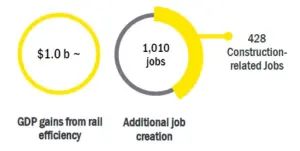
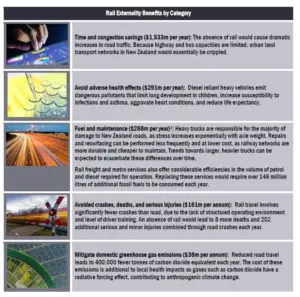
It follows ARA’s report by Ernst & Young which estimated that in the 2023-24 year that the existence of rail services contributed $3.3 billion to New Zealand each year, comprising approximately $1 billion in Gross Domestic Product (GDP) benefits as well as $2.3 billion of economic externality impacts and 1,010 jobs annually, based on economic impact analysis.
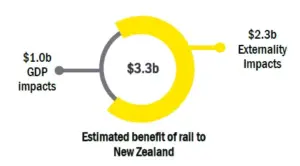 This uplift in GDP includes the stimulation of net exports by approximately $97 million across a variety of New Zealand firms, the report said, arising from the price-competitiveness realised from the productivity benefits that rail provides.
The ARA report also endorsed investing in the metropolitan rail networks to support the efficient movement of people in Auckland and Wellington.
Effects for the private sector, the report says, are concentrated in the construction sector, wholesale and retail trade, as well as dairy and coal.
These macroeconomic effects consider wider implications for employment, competition and productivity, and thus are considered in addition to the externality benefits.
 These benefits are “bottom-up”, in the sense of affecting individual New Zealanders. They predominantly consist of externalities, defined as costs or benefits affecting third parties that are not involved in the transaction or decision — for example, a pedestrian experiencing lung disease due to diesel exhaust fumes.
Released at the ARA’s RailNZ 25 conference in Auckland, the third study, Building New Zealand Rail Skills for the Future makes several key recommendations, including that the government review the New Zealand Rail Network Investment Programme to ensure long-term certainty for the industry.
The report, prepared by PwC, also recommends procurement frameworks and policies be reviewed to prioritise local workforce development as well as regulatory reform to enhance interoperability and reduce barriers to adopting new technologies.
 ARA Chief Executive Caroline Wilkie says the report provides a blueprint to overcome mounting workforce pressures, including an ageing workforce, skills shortages and limited training pathways.
“This report lays the groundwork for a national rail workforce strategy to address critical skills gaps, particularly in highly specialised areas, that will support long-term infrastructure delivery and meet future demand for rail services,” Wilkie said.
“With more than one in four rail workers expected to retire in the next decade in New Zealand, now is the time to implement forward-thinking measures that support a more sustainable rail workforce.”
The report – which found only 27 per cent of rail organisations offer apprenticeships or scholarships – also recommends increasing attraction and retention rates through diversity initiatives, reshaping outdated perceptions of rail and developing rail courses at university to help expand entry pathways.
Deputy Chief Executive of the Hanga-Aro-Rau Workforce Development Council for the manufacturing, engineering and logistics sectors, Samantha McNaughton, said the future of New Zealand’s rail sector hinges on a skilled, future-ready workforce.
“This report highlights the critical need for coordinated action to attract and retain talent, invest in training, and align workforce development with our infrastructure ambitions,” McNaughton said.
The report notes the industry is experiencing rapid technological advancements, with digitalisation, automation, and sustainability initiatives transforming rail operations. It says rail operators, government and education providers must collaborate to support skills in specific areas such as digital signalling, traction maintenance, and cyber-secure operations.
“To remain competitive and future-ready, New Zealand must prioritise workforce upskilling, international collaboration, and investment in training pathways aligned with sector needs.
Ensuring a sustainable pipeline of skilled workers will be critical in supporting ongoing infrastructure investment and rail expansion projects,” the report states.