

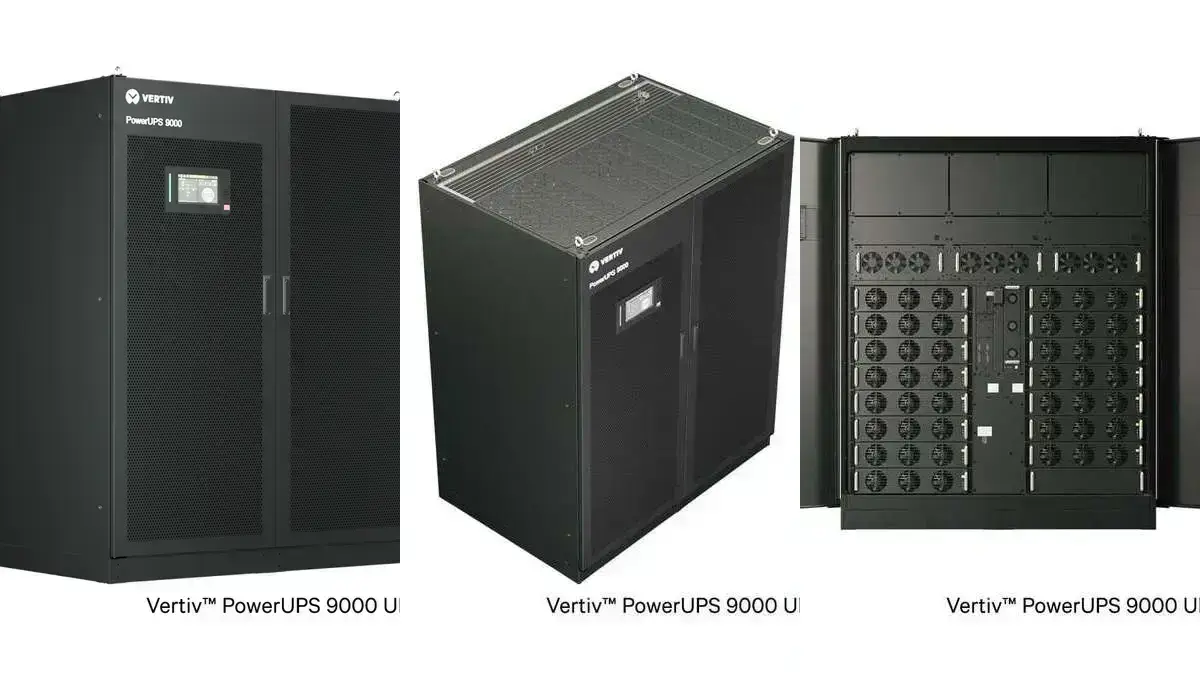

Vertiv has expanded its PowerUPS 9000 uninterruptible power supply range with a 1.8 megawatt model, now available across Southeast Asia, Australia and New Zealand.
The new unit is aimed at large data centres, artificial intelligence installations and other critical applications. It extends the PowerUPS 9000 platform beyond the existing 250kW to 1250kW range and is designed to deliver more power protection within a compact footprint.
The launch comes as operators of AI infrastructure face sharper swings in electricity demand from graphics processing unit clusters. Those clusters can move from low use to peak demand within milliseconds, creating rapid changes that can affect batteries, switchgear, generators, transformers and utility connections.
That pattern has pushed power equipment suppliers to adapt systems originally developed for steadier data centre loads. Vertiv said the 1.8MW model adds control functions to manage abrupt load transitions and support more stable operation in environments with highly variable demand.
The system includes Battery Shield technology to reduce unnecessary battery cycling during sudden load changes. It also includes Input Power Smoothing, intended to make input power flow more predictable and reduce strain on upstream electrical infrastructure.
Those functions work alongside state-of-charge management designed to preserve battery availability for backup use while helping maintain stability in high-density computing environments. Vertiv positioned the new model as part of a broader approach linking power and thermal infrastructure for AI and enterprise data centres.
AI demand
Rising rack densities and pressure on white space have become central issues for operators building new AI facilities or retrofitting existing sites. Power systems in these environments must handle not only larger total loads, but also load profiles that can change faster than conventional enterprise applications.
Vertiv said the 1.8MW model builds on the high-power-density design of the PowerUPS 9000 family. The system was also developed with attention to energy efficiency, serviceability and deployment flexibility.
Testing has become a key point for infrastructure suppliers trying to show that equipment can cope with AI-related demand patterns. Vertiv said it tested the control technologies using its own AI load simulator across a range of workload profiles, battery configurations, duty cycles and fluctuation ranges.
According to the company, those tests showed stable input current behaviour despite extreme output variability. The results suggested the system could help protect both battery systems and upstream electrical infrastructure under simulated AI operating conditions.
In Singapore, Vertiv also worked with STT Singapore on testing intended to reflect real-world AI infrastructure conditions. That work included rapid load transitions and coordination between UPS operation, energy storage systems and upstream power infrastructure.
Executive comments
Tony Gaunt, Vice President for Product Management, Vertiv Asia, described the effect AI is having on infrastructure design.
"AI is fundamentally changing data center infrastructure requirements across Asia, driving demand for higher-density power systems that can respond faster and manage the effects of these dynamic AI workloads," said Gaunt.
"With the expansion of the Vertiv(tm) PowerUPS 9000 family, we are helping customers scale critical power infrastructure to maximum utilization factors while supporting the resilience, flexibility, and operational continuity required for future-ready AI deployments," he added.
Arunangshu Chattopadhyay, Director of AC Power and Power Distribution, Vertiv Asia, said older systems were not built for the load patterns now seen in GPU environments.
"Traditional UPS systems were not designed for the rapid and repetitive load transitions created by modern GPU environments," said Chattopadhyay.
"The latest expansion in the Vertiv PowerUPS 9000 family incorporates Vertiv's advanced control, patented technologies that help stabilize power behavior during extreme load fluctuations, while preserving battery health and reducing stress on upstream electrical infrastructure," he said.
Vertiv, headquartered in Westerville, Ohio, operates in more than 130 countries. The company sells power, cooling and IT infrastructure products and services for data centres, communications networks and industrial and commercial facilities.