

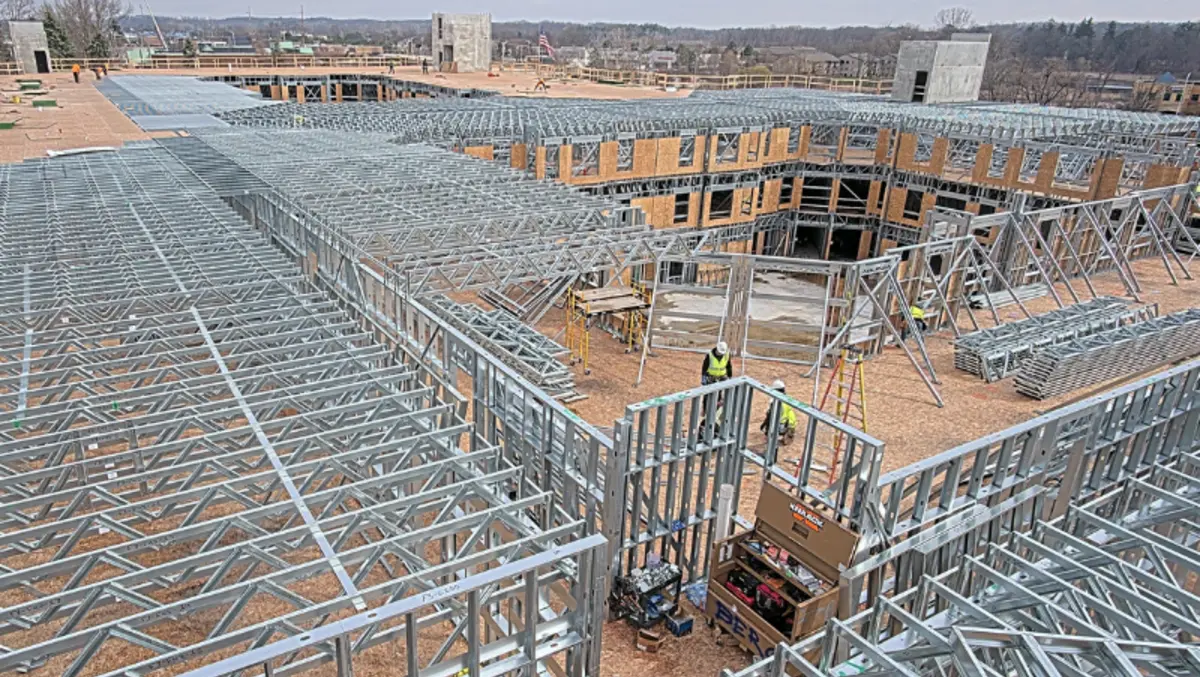
Michigan apartment project cuts framing time by 30%
Tue, 11th Aug 2026 (Today)
DTN Management switched a Michigan apartment project from wood framing to cold-formed steel during construction, cutting projected framing time by 30% at The Vista at Brighton, according to the companies involved.
The Vista at Brighton is a 233-unit, 313,000-square-foot multifamily development. It had already been permitted for wood framing and was under way when DTN Management changed course, citing rising insurance costs as one reason.
Intellisteel designed, engineered and manufactured the steel framing, while Wolverine Group served as general contractor. The team used FRAMECAD software and manufacturing systems to prepare framing components offsite before delivery to the Michigan site.
Intellisteel's bid came in USD $5 per square foot below the original wood design, before any savings from lower insurance premiums, the companies said. Framing parts arrived cut to length, with service and fastener holes already punched, and studs pre-swaged and pre-notched.
That reduced cutting and adjustment work on site and limited rework during installation. Despite the switch after construction had begun, framing remained on schedule, Wolverine Group said.
Data from the Brighton project offers a snapshot of how some US builders are managing labour shortages and cost pressure. It also suggests developers can change framing systems after permitting without necessarily disrupting delivery.
"At peak efficiency, we installed 20,000 square feet of load-bearing walls and trusses weekly," said John Law, Project Superintendent at Wolverine Group.
Law also compared the outcome with a project built in steel from the outset. "Had the project started the way we finished with Intellisteel, we would have finished the framing in just four months, which would have been two months ahead of schedule, or 30 percent faster than traditional methods," he said.
Labour pressures
The project comes amid a broader squeeze in the US construction labour market. Builders continue to report difficulty finding skilled workers, while competition for trades has intensified as large data-centre projects pull labour into other parts of the market.
Rather than rely solely on hiring, some contractors and developers are using design for manufacturing and assembly, or DfMA, to reduce the amount of work done in the field. Under that approach, more design coordination and manufacturing is completed before materials arrive on site.
At Brighton, Intellisteel involved Wolverine Group and mechanical, electrical and plumbing contractors early in the process. The framing package was detailed in 3D so plumbing stacks and service penetrations could be resolved before manufacturing began.
That early coordination was important because the project changed material systems after the original wood design had already been permitted. The companies said the switch highlights how developers are reassessing established construction methods as insurance, labour and delivery pressures reshape project economics.
"We can deliver high-quality cold-formed steel structures in half the time it would take with traditional methods, all while cutting costs and reducing the need for onsite labor," said Stanley Adwell, Founder and CEO of Intellisteel. "You just can't match the speed of cold-formed steel construction."
FRAMECAD, founded in New Zealand, said its systems are used in more than 100 countries for steel-framed residential and commercial buildings. In Brighton, its role was to support the design-to-manufacturing process Intellisteel used to produce machine-ready components for installation.
The case is likely to draw attention from developers weighing alternatives to wood framing in multifamily housing, particularly where labour availability and insurance costs are shifting assumptions made early in the planning process. It also points to a more flexible procurement model, in which a project can be redesigned midstream if the economics change.
"U.S. builders can't hire their way out of this shortage," said Tim Lindquist, Regional Director - FRAMECAD Americas. "By engineering the framing upfront and manufacturing it offsite, we take complexity out of the field so builders can install more square footage faster, with fewer errors. Brighton shows this is not a future concept. It is working on American jobsites today."