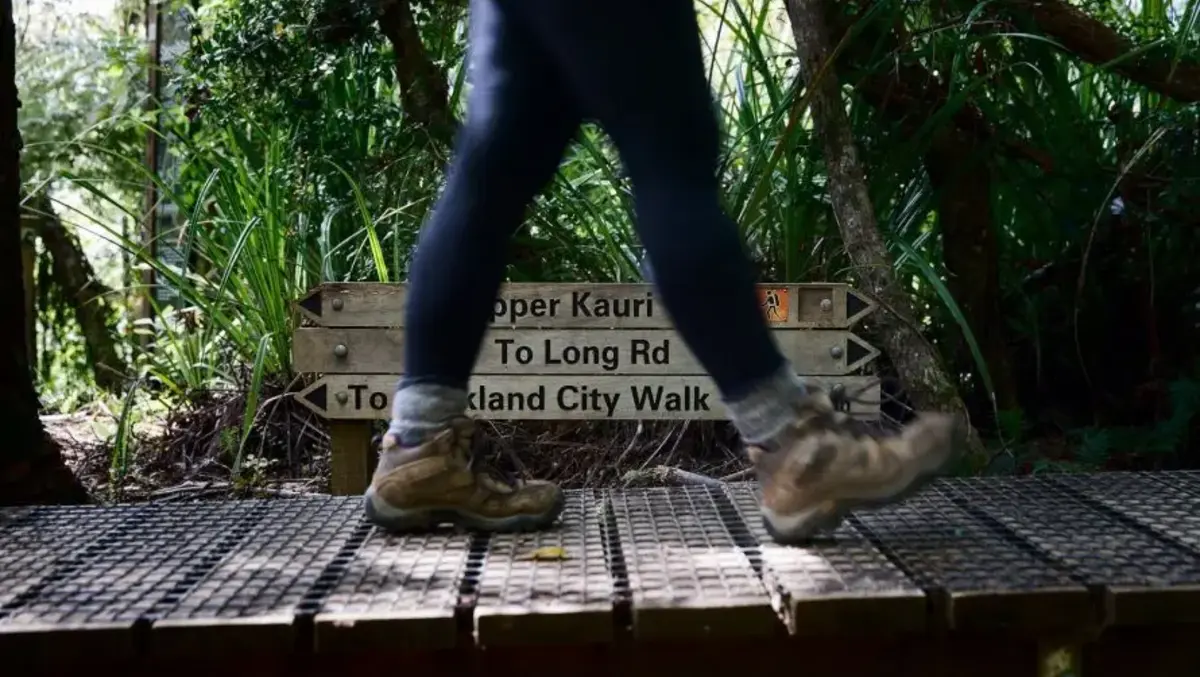
Auckland's targeted forest rate helps reopen 109 tracks
Mon, 9th Nov 2026 (Today)A targeted rate introduced eight years ago to help keep Auckland's forests from diseases has helped upgrade 173 kilometres of tracks, roughly the driving distance from Titirangi to Whangārei.
The funds have also helped re-open 109 tracks, a report has revealed.
Introduced in 2018, the Natural Environment Targeted Rate (NETR) saw Aucklanders fork out $44 a year to protect trees from kauri dieback disease and prevent its spread.
The disease, a microscopic fungus-like organism called Phytophthora agathidicida, spreads through soil, infects roots and starves a tree of nutrients and water.
Since 2019, the NETR's track upgrade capital works programme has invested $49.43 million into track upgrades and hygiene infrastructure at Auckland's regional parks.
The programme concluded in June this year.
Auckland Council head of natural environment delivery Phil Brown told the Community Committee the work to protect kauri was far from over.
"There is still a lot to do," Brown said. "Of the tracks that were identified for upgrades, 21 remain closed at the end of the NETR-funded programme."
Over seven years, the NETR programme upgraded 173km of tracks across regional and local parks, reopened 109 tracks and installed 135 hygiene stations in parks, 12 hygiene stations at wharves and three vehicle wash stations.
Brown said the council would continue to upgrade and re-open tracks through alternative funding sources, including the regional capital work programme.
The work to protect Auckland's forest from dieback began in 2017 when local iwi Te Karewau ā Maki imposed a rāhui, or ritual ban, to stop access into Waitākere Ranges. The forested areas of the ranges were officially closed off by the council in May 2018.
A 2017 council study found the disease had spread extensively – nearly a quarter of trees in the 2571ha West Auckland kauri forest were infected or possibly infected.
Community Committee chair, councillor Julie Fairey, said closing tracks and restricting access back then was difficult but necessary.
"Kauri are an irreplaceable part of Auckland's identity, and we had a responsibility to act when the science showed their survival was at risk," Fairey said.
"The investment Aucklanders have made through the Natural Environment Targeted Rate (NETR) has helped protect these precious forests while carefully reopening tracks, so people can enjoy them and the ngahere can be safeguarded for future generations."
The NETR programme upgraded tracks, improved drainage, installed hygiene stations and provided safer alternatives, helping keep visitors away from sensitive kauri root zones and reduce the risk of spreading kauri dieback disease.
In the Waitākere, work was delivered in partnership with Te Kawerau ā Maki and an agreement guided the planning and prioritisation of upgrades.
Te Kawerau Iwi Tiaki Trust chief executive Edward Ashby said a careful, adaptive approach enabled 81km of tracks to reopen in the Waitākere.
"Our focus now is the next stage, including progressing Te Ara Tuhura / Hillary Trail as a multi-day circular walking network and exploring further access opportunities in lower-risk areas of the Waitākere Ranges."