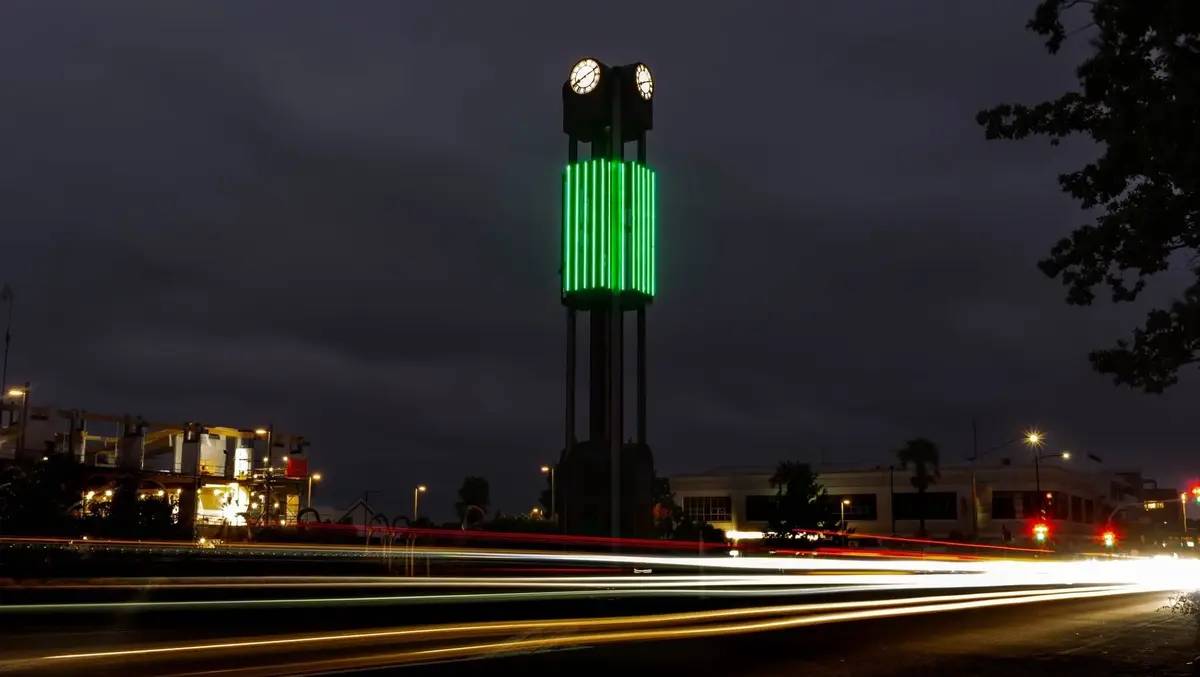
Ashburton abandons street flags for another bright idea
Wed, 25th Nov 2026 (Today)Ashburton's iconic clock tower will get a brand-new set of lights next year using money flagged for something else - banner flags on the main street.
The flags, which change seasonally along the main street in Ashburton, are set to be phased out as councillors indicated $425,000 over 10 years, funded by financial contributions (specifically reserve contributions) not rates, would be removed from the draft long-term plan.
Councillors are working on the long-term plan budget, which sets out the district's priorities for the next decade, over a series of workshops to prepare a draft for public consultation early next year.
When the flags came up at the budget workshop on Tuesday, Cr Phill Hooper and Cr Russell Ellis both said they believed they had previously been scrapped, and if not, wanted them removed.
Cr Phill Everest said that even if the flags don't impact rates, it was still money being spent that could be better spent elsewhere on core business.
Cr Tony Todd said he would "sooner spend the money on twinkly lights or something nicer".
He had been talking about the ones along the trees on East Street, which are being extended this year in an already approved project.
Ellis had suggested swapping the money from the flags to the clock tower lights that had been left out of the draft budget but wasn't sure if it was eligible to use the reserve funding.
The $67,000 business case for a new lighting system in the clock tower was also pulled back in, with business support group manager Helan Barnes confirming the project could be covered by financial contributions.
Some of the lights are not functioning already, but it needs a full replacement due to being an outdated system on the clock, which celebrates its 50th anniversary on Thursday.
Cr Carolyn Cameron was horrified it hadn't been included to begin with, saying the clock tower "goes on all the postcards" showing off Ashburton. And not fixing the lights would result in "a dismal wee clock out the front," she added.
"I don't think you can have a town clock without the jolly lights, that's a bit grim. We might as well not mow the front berm. It's just as bad."
Cr Richard Wilson said it was more important than some other renewal projects they are considering spending money on, singling out park benches in a nod to his argument that the open spaces budget is "extravagant and unaffordable".
He felt the clock tower light was a high-priority renewal and "better than flags".
Todd said he supported the clock tower lights as the front of the council building because it was "our shop window".
"It's what we are judged on."
The councillors indicated to include the project in the first year of the LTP.
Dog fees to go towards dog parks
Dog registration fees are proposed to start paying for the district's dog parks.
It costs around $51,000 a year to operate the district's dog parks, and that is funded by the urban amenity rate and general rate – not dog registration fees, as the land is considered open space.
Dog registration fees fund animal control services, complaint responses, public patrols, pound facilities, education, administration and the National Dog Database.
The cost to run dog parks was estimated to include $34,000 for mowing, $5000 for maintenance, and $12,000 for the free dog waste bag system.
The council is signalling that the dog registration fees will now contribute $10,000 per year to cover those costs.
Open spaces general manager Toni Durham said even if it wasn't a dog park, the council would have mowing costs as it does for any reserve land.
"Some of it is to a higher level of service than what we would provide at a general neighbourhood park."
Cr Deb Gilksion was surprised dog parks received more frequent mowing than other parks and reserves, and her suggestion to scale back the mowing in line with other parks, reducing the cost by an estimated $5000, was supported.
The majority supported starting at $10,000 in the draft annual plan.
Cameron felt the dog fees should be covering closer to $30,000 in line with an overall stronger shift to user-pays models.