BWA Insolvency principal Bryan Williams says the sharp rise in business failures reflects pressures that have built over several years and are now coming to the surface. The large number of closures is unlikely to hinder the broader recovery that many forecasters expect to continue through 2026, he says.

Bryan Williams, Principal BWA Insolvency
Williams believes the 2025 closures reflect the challenges of recent years, not the conditions we are moving into. “Their only connection to today’s economy is that they continue operating within it, without the financial strength to survive,” he says.
“Despite the positive economic mood that emerged late in 2025, the insolvencies we are seeing today are rooted in earlier events. Old debt, thin margins and stalled projects are what ultimately undermine a company’s viability,” says Williams.
“By the time a business enters liquidation, the conditions that caused its distress are already in the past. The improvements we are seeing now in interest rates, building activity and export returns arrive too late for those already in deep financial trouble.”
Williams said directors of distressed companies should not rely solely on improving economic sentiment when considering their next steps.
“It is natural to hope that better times will solve current problems but continuing to fight a battle that cannot be won without new capital is exhausting and often futile.
“Directors should be decisive and seek early advice. Restructuring options are available that can preserve value, protect jobs and provide a more orderly way forward.”
While construction had the highest number of insolvencies in 2025, the rate of new insolvencies in the sector is slowing, with a 9.3 percent year-on-year — much less than the sharp increases seen in previous years
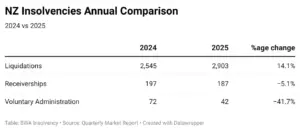
Still, the reality is that the latest BWA Insolvency Market Report confirms New Zealand experienced its highest level of business insolvencies in 2025 since the Global Financial Crisis. There were 3,132 liquidations, receiverships and voluntary administrations recorded in 2025, an 11.3 percent increase on 2024 and the highest annual total in 15 years*.
The final quarter of 2025 saw a significant increase in appointments, reaching 933 cases. This was a 31.5 percent increase on the same quarter in 2024 and the strongest quarterly rise of the year.
Liquidations increased from 666 to 891 during the quarter while voluntary administrations rose from six to 16. Receiverships decreased from 37 to 26.
Williams said the latest business confidence results show genuine signs of improvement in economic sentiment, yet they co-exist with persistent financial strain for many companies.
“New Zealanders have had enough of doing hard and there is a genuine lift in confidence. A rising tide will benefit many businesses, but it will not reverse the trajectory for those that are already insolvent,” he adds.
“A bit of extra revenue can provide temporary relief, but it is rarely enough to overcome the weight of historic debt. The cost of those past problems is often greater than the benefit of any new earnings.”
Several consumer-facing and cost-sensitive sectors saw substantial increases. These included food and beverage, repair and maintenance, personal services, retail trade, transport and delivery and manufacturing.
Williams said the large number of closures is unlikely to hinder the broader recovery that many forecasters expect to continue through 2026.
“These closures reflect the challenges of recent years, not the conditions we are moving into. Their only connection to today’s economy is that they continue operating within it, without the financial strength to survive,” he said.
“One positive is that employees from these companies can be absorbed into sectors that are strengthening. Moving these workers into growing industries is a helpful result from what is otherwise a tough situation.”
About BWA Insolvency
BWA Insolvency is a leading insolvency firm which supports New Zealand businesses through liquidations, receiverships and voluntary administrations. The company has been tracking data on liquidations, receiverships and voluntary administrations since 2012. The Registrar of Companies Office records the filings of companies that have gone into a formal state of insolvency. BWA Insolvency then does a deeper investigation to show industry trends and provide a detailed snapshot of what’s happening in the market for the Quarterly Market Report.