

Autonomous cargo bikes represent a different approach to moving people and goods through cities. Two of the most promising uses include autonomous shared bikes that come to you on demand and cargo bikes that are reshaping how parcels and post are delivered in urban areas, says Transport Leader.
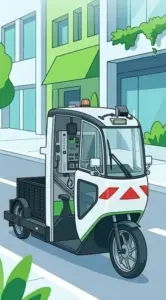
At their core, autonomous cargo bikes are three-wheeled electric cargo bikes capable of travelling without a rider. In manual mode, they function as a standard e-bike, ridden in the usual way.Â
In autonomous mode, they can navigate independently, following a route, avoiding obstacles, and repositioning themselves without (almost) any human input.
Together, these applications paint a picture of a technology that is quietly maturing and that has the potential to make a meaningful dent in congestion, emissions, and logistics costs.
The three-wheeled design is important. It provides significantly greater stability than a traditional two-wheeled bike, which has implications not just for safety, but for regulation, particularly around helmet requirements.
The autonomy is what changes everything. A bike that can move itself unlocks entirely new operating models that simply are not possible with conventional shared bikes or human-operated cargo vehicles.Â
It can come to you rather than waiting at a docking station. It can reposition itself to where demand is highest. It can follow a delivery worker on their route, removing the need to stop and move a vehicle forward by hand constantly.
Two uses stand out as particularly compelling:
- Shared bikes — on-demand, self-repositioning bikes that could transform urban cycling programs
- Parcel and postal delivery — autonomous support vehicles that work alongside delivery workers to improve efficiency.
Autonomous Shared Bikes
Bike share schemes are great, but they have limitations. Bikes end up clustered in the wrong locations, blocking footpaths and requiring expensive manual redistribution just to keep the service functional.Â
Utilisation during off-peak periods is low, and first and last-mile connections to public transport, one of the most promising use cases for shared bikes, have proven particularly difficult to make work without heavy subsidies. Lots of bikes are required, so they are in the right location at the right time for users.
Autonomy has the potential to change this:
Convenience: Rather than walking to a location, users simply book a bike through a mobile app, and it comes to them. This single shift, from user-goes-to-bike to bike-comes-to-user, dramatically improves convenience.
Parking:Â One of the persistent frustrations with shared bike schemes is poorly parked bikes. With autonomous bikes, this largely disappears. A bike that can move itself can also repark itself in a better location after being left by a user.
Redistribution: the costly process of manually moving bikes to where demand is, is similarly transformed. Rather than relying on vans and staff to rebalance the network, autonomous bikes can reposition themselves in response to real-time demand patterns, significantly reducing operating costs.
Modelling suggests that fewer autonomous shared bikes are needed to deliver the same level of service as a conventional shared bike fleet, reducing the resources required for the fleet.
Perhaps the most exciting application is in first and last-mile connections to public transport. This is an area where conventional shared bikes have consistently underperformed, held back by the costs of ensuring availability and redistribution.
Autonomous bikes rewrite this equation. In the morning, a bike can travel to a user’s door, be ridden to a station, and then autonomously go to the next passenger. Once the morning peak subsides, the same bikes can reposition to wherever daytime demand exists, before returning to stations ahead of the afternoon peak.Â
The result is a dramatically more efficient operation, higher utilisation and a service that actually works for commuters at both ends of their journey.
ChallengesÂ
The case for autonomous shared bikes is compelling, but it is not without challenges.
The most immediate is cost. Autonomous bikes currently carry a price tag many times higher than a conventional shared e-bike.
Vandalism, a problem that plagued early dockless bike schemes, could also be a challenge.
Infrastructure also matters. Cities with poor cycling infrastructure will still see limited uptake regardless of how convenient the product.
Finally, regulation will need to keep pace. Speed limits for e-bikes are already a contentious issue in many jurisdictions, and overly conservative limits could undermine the commercial viability of autonomous shared bike services.Â
Helmet requirements are another area worth revisiting. The stability of a three-wheeled cargo bike is substantially greater than that of a conventional bicycle, and policies designed for two-wheeled cycling may not be appropriate here.
It is not hard to imagine a world where autonomous cargo bikes deliver a significant uplift to shared bike programs, making them more common in more parts of cities and providing improved connections to public transport hubs.
Parcel and Post Deliveries
The last-mile delivery problem is one of the most stubborn challenges in urban logistics. It is the most expensive part of the delivery chain and the hardest to optimise.Â
A delivery worker spends a significant proportion of their day not delivering but parking, repositioning their vehicle, returning to a depot to reload and navigating routes that were planned hours earlier without knowledge of real-time conditions.
Autonomous cargo bikes will not solve all of this. But they offer a genuinely interesting set of capabilities that could meaningfully improve last-mile delivery economics, particularly in dense urban environments where cargo bikes have already proven their worth.
Following the postie
Postal services in many countries already use motorbikes to support delivery workers, transporting both the worker and the mail they are carrying. A key drawback is that the vehicle must be constantly moved forward from one stop to the next, consuming time.
An autonomous cargo bike changes this dynamic entirely. Rather than the delivery worker moving the vehicle, the vehicle follows the worker, autonomously keeping pace as they move from door to door. Early modelling suggests this alone can improve delivery efficiency by around 20 percent.
The benefits do not stop there. Rather than a worker having to return to a depot or vehicle to reload, an autonomous bike can meet them at the start of their next delivery route fully loaded and ready to go. The worker stays in the field; the logistics work itself out around them.
Optimising parcel deliveries
For parcel delivery companies, a major source of inefficiency is the time spent returning to a depot to reload. A bike that can be dispatched to meet a delivery worker mid-route effectively extends how much a single worker can deliver in a day without returning to base.
Real-time route optimisation is another advantage. An autonomous bike that is continuously connected can adapt to changing conditions, new parcels added to a route, a recipient who is now available, a street that has become congested, in ways that a pre-planned human-driven route cannot.
Autonomous bikes vs delivery robots?
Delivery robots are already operating in a number of cities, and the range of autonomous last-mile solutions on offer is only growing.Â
In dense urban environments where footpaths are busy and fully autonomous robots face public resistance or regulatory constraints, a hybrid model of an autonomous bike paired with a human delivery worker may well be the most practical solution for some time to come.Â
The human handles the door-to-door interaction; the bike handles the logistics. It is a division of labour that plays to the strengths of both.
Cargo bikes have already demonstrated their value in inner-city delivery contexts. Adding autonomy makes them significantly more efficient and keeps them competitive against the growing range of alternatives.
The future
As shared vehicles, they have the potential to transform bike-share programs, making them more convenient, more efficient, and genuinely viable as first and last-mile connections to public transport.Â
As delivery vehicles, they offer a middle ground between traditional human-operated logistics and fully autonomous robots, keeping the benefits of a human while cutting costs and improving efficiency.
Challenges remain. Upfront costs are high, regulatory frameworks need to catch up and the quality of cycling infrastructure will continue to be a limiting factor.
What is clear is that the cities best placed to benefit will be those that start thinking now about how autonomous cargo bikes fit into their broader transport and logistics strategies, from cycling infrastructure investment to regulatory settings and procurement frameworks.
The technology is closer than most people realise.Â
To subscribe to the Transport Leader Â


