A multi-million-dollar Christchurch facility underway for Daikin will upcycle climate-damaging refrigerant from end-of-life heat pumps into its operations, preventing it from entering the waste stream. It is part of a 30-year investment to strengthen long-term logistics capability, address skills shortages and build sector infrastructure to support the transition towards electrified, low-emission buildings
Under New Zealand’s commitments through the Kigali Amendment to the Montreal Protocol, high global warming potential refrigerants must be phased down by more than 80 percent by 2037.
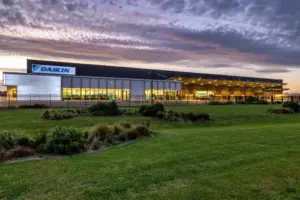
Daikin’s initiative, which is part of the design and operation of the new 7,861sqm Daikin Park Christchurch logistics and industry training facility, integrates refrigerant reclamation and reuse rather than relying solely on newly manufactured refrigerants or treating recovered gases as waste at end of life.
The fully electric facility has been awarded a 5 Green Star Design and As-Built rating and includes a 100kW rooftop solar system, electric vehicle and materials-handling charging infrastructure, and a heat recovery HVAC system capable of simultaneous heating and cooling across different areas of the building.
The recycling model is supported by a nationwide network of hundreds of Daikin-accredited installers who are able to intercept end-of-life residential and commercial heat pump systems before units enter the waste stream.
The recovered refrigerant is captured, consolidated and sent for reclamation rather than being vented or destroyed, creating a supply of reusable refrigerant for redeployment in new and existing systems.
Under the programme, refrigerant recovered through that network has been cleaned and reprocessed to international purity standards, then recommissioned for use across the Christchurch facility’s own heating and cooling systems.
Ryuta Hayashibara, managing director of Daikin New Zealand, says tightening refrigerant import controls, emissions pricing and constrained supply of high-global-warming-potential gases are becoming a material commercial consideration for building owners and operators.
“As supply caps tighten and emissions pricing is applied, the cost of servicing and replacing refrigerant is becoming a more material part of building operating costs.
Efficient heat pumps
“At the same time, refrigerants are a critical enabler of high-efficiency heat pump technology. They allow modern systems to deliver low-emissions heating and cooling, so the focus needs to be on managing this resource properly — minimising losses, improving recovery and using it more efficiently, rather than treating it as disposable.
“Developing practical models that work operationally and commercially is essential if the sector is going to scale responsibly,” he says.
Hayashibara says the South Island’s colder and more variable climate, including longer heating seasons and more extreme winter lows, is driving stronger demand for heat pumps and commercial heating systems, increasing both refrigerant volumes in use and the importance of how those gases are managed.
“This facility supports growing demand for electric heating and cooling in the South Island, but it also reflects the need for more control over supply chains, service response times and refrigerant availability as regulations tighten.
Training facility
“Integrating our Christchurch operations under one roof was a strategic decision to enhance customer experience, strengthen warehousing capability and improve responsiveness in an industry where we’ve achieved year-on-year market share growth, including sustained expansion across trade sales, accessories and our new CO2 hot water category.
“Our new Training Academy and working showroom are central to that approach. The HVAC sector is evolving rapidly, with increased focus on energy efficiency, refrigerant management and overall system performance. Providing a live environment where customers and partners can see systems operating in real-world conditions helps lift capability across the industry.
Environmental footprint
“Consolidating operations has given us greater oversight of our environmental footprint while demonstrating the practical application of new HVAC technologies. Ultimately, this facility provides a platform for long-term, sustainable growth and reflects how integrated operations can strengthen both business performance and industry standards.”
Independent lifecycle analysis by Japanese researchers shows reclaimed refrigerant can reduce the carbon footprint of refrigerant supply by between 72 and 90 percent, depending on the gas type, compared with producing and importing new refrigerant. While these results reflect overseas supply chain conditions, they highlight the potential lifecycle benefits of refrigerant reuse if similar recovery, processing and distribution systems can be implemented at scale, supported by a coordinated domestic supply chain.
Ryan Philp, head of sustainability at Daikin New Zealand, says the broader focus for the company is on strengthening lifecycle refrigerant management across the industry.
“For us, this is about managing refrigerant responsibly across its full lifecycle — from system design and installation, through operation and servicing, to decommissioning at end of life.
Training and technical support
“That includes investing in training and technical support for installers and engineers, improving product design with enhanced safety features and monitoring controls, and making informed decisions about when refrigerant should be sent for destruction versus when it can be safely recovered and reused.
“Refrigerant is a critical resource that enables high-efficiency heat pump technology, and managing it properly is essential if the industry is going to move toward more circular, low-emissions operating models,” he says.
The site has the capacity to distribute around 450,000 cubic metres of freight per year, and more than 6,400 pallet spaces across racking, rooftop storage and specialist duct and parts zones.
The facility also houses the company’s South Island sales team, trade centre, showroom and a dedicated training academy focused on developing technician capability as the sector transitions toward electrified heating systems and tighter refrigerant handling
A timely and replicable upgrade
Daikin’s reclaimed refrigerant initiative has been recognised under the Green Star innovation framework, positioning it as a replicable approach for future commercial and industrial developments.
Ryan Philp, head of sustainability at Daikin New Zealand says the model could be applied to other large facilities such as hospitals, data centres and complex commercial buildings where refrigerant volumes are significant.
Latest Government data shows fluorinated gases account for around two percent of New Zealand’s total greenhouse gas emissions, with approximately 94 percent of these emissions coming from hydrofluorocarbons (HFCs).
HFCs are widely used as refrigerants across multiple sectors, including heating, ventilation and air conditioning systems, automotive air conditioning and household appliances.
While fluorinated gases represent a relatively small share of total emissions, many commonly used refrigerants have high global warming potentials, meaning even small releases can have a disproportionate climate impact compared with carbon dioxide.
Government modelling also shows that without further intervention fluorinated gases are projected to contribute more than seven million tonnes of carbon dioxide equivalent over New Zealand’s first emissions budget period. highlighting the scale of the issue facing the building and infrastructure sectors.