Instead of slavishly following the US down a trail of last-gasp fossil fuels with billion-dollar dead-money investments, we could look to Europe where sustainable substitutes for traditional methane gas (of which our herds obligingly produce an endless supply) like biogas and RNG applications will play a key role, says Publisher Mike Bishara.
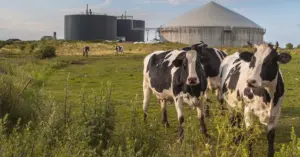
In Europe, for example, the REPowerEU2 plan is set to produce 35 billion cubic meters of biogas and biomethane per day by 2030 as an affordable, sustainable power source.
The sustainable future is clearly in these efforts by using historical waste product to supplement the current supply chain for natural gas.
No one is denying the need for a measure to limit price hikes in the short term but trying to sell it as a positive investment beggars belief. We need to seriously address the elephant in the room at the same time.
The price in real terms, especially for SME, caused by years of under investment in renewables by successive governments has hit home and has businesses tumbling over at record rates. We need to get our heads out of a three-year cycle election mentality and invest for the future with a non-partisan solution — in this case at a fraction of the cost.
It is not just a bunch of beleaguered farmers we are seeking to help. In communities and business across the globe, daily life creates waste that can be challenging to manage, including agriculture byproducts, livestock manure and even leftover or discarded food which all generate organic waste that produces methane decomposition.
Methane is the second most important radiative forcing agent among all the anthropogenic trace greenhouse gases, with a climate warming effect second only to carbon dioxide.
The long-term secular rise of atmospheric methane concentrations is, unsurprisingly, due largely to anthropogenic methane emissions from agriculture, the oil and gas industry and waste management, which together contribute more than half of all global methane emissions.
Many factors have the potential to influence atmospheric methane concentrations, including changes in emissions from agriculture, wetlands, permafrost, wildfires and the oil and gas industry, which themselves depend on drivers such as climate change, rainfall changes caused by El Niño/La Niña, and economic factors, all of whose impacts can be difficult to attribute and untangle from each other.
Emissions produced in developing biogas, while a more efficient use of methane and a great use of commonly wasted materials, can still play a negative role in our environment. We can tame this monster.
Frank Zahorszki of ITEMA GmbH in Germany, is working to remedy these emissions from biogas and RNG in the production process.
“Biogas is a great way to utilize common waste in our world, but we want to ensure we are doing all we can to ensure a clean environment,” Zahorszki explains.
According to the US EPA, the United States saw 760.8 million metric tons of CO
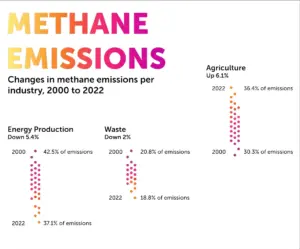
2 e methane emissions in 2022, with 36.4 percent and 18.8 percent of those coming from agriculture and waste, respectively.
Zahorszki, who has 20 years of experience as a technology specialist in various industries, says keeping gas emissions in check won’t be easy.
“Finding these leaks in the biogas industry can often be challenging and time consuming … unless you’re using advanced technology,” he says.
Optical Gas Imaging
Enter optical gas imaging (OGI) technology — specialized infrared cameras that are filtered to match the wavelength of specific gases such as methane.
Using advanced technologies like quantitative OGI will allow those in the industry to not only detect these leaks but also have a new visibility into the severity of the emissions and garner a better understanding on how to resolve the problem
Biogas is produced when organic materials such as plant and animal waste are broken down using an anaerobic digestion process. Bacteria break down the byproducts to create energy in the form of gas and digestate materials such as fertilizer.
Biogas can be additionally refined to produce renewable natural gas (RNG), or biomethane, and be used in a variety of forms that include heat and electricity, fuel for vehicles, bioplastics and even conventional gas that is added to the pipeline to supplement the natural gas grid.
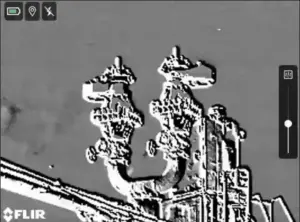
Digester pumps, like the one seen in this optical gas imaging video, move biomaterials to anaerobic digesters. Because the material is fermenting, the potential for a methane leak is high.
Advantage of OGI
Using OGI cameras such as the FLIR G-Series allows operators to see emissions that are completely invisible to the naked eye or most other technologies.
These cameras work in real time to visualize gases for an immediate understanding of emission events. Live streaming video of leaks, which look similar to smoke, make it easy for technicians to pinpoint the exact source of leaks and determine how to fix the problem.
With unique features such as High Sensitivity Mode and patented ergonomics for optimal camera operating positions, FLIR G-Series cameras can make detecting methane leaks 10-times faster than using traditional leak detection and repair (LDAR) methods.
Biogas facilities are often large with many potential leaking locations from pumps to roof seals. Since OGI technology allows a user to quickly scan across wide target areas, companies can maximize efficiency of their LDAR operations.
In the biogas industry, OGI technology is ideal for detecting and measuring methane emissions from a safe distance, keeping operators away from potential safety hazards while maximizing efficient operations.
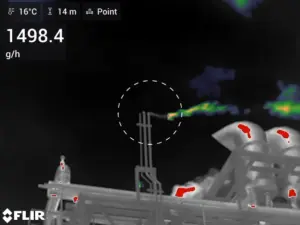
Methane leak quantified using a FLIR Gx320 camera.
More recently, the OGI technology has advanced to the point of including emission quantification in the cameras.
“For years, OGI cameras made finding leaks easy and efficient, but measuring them was often a challenge. Now with FLIR’s G-Series cameras I can immediately measure the emissions at the same time I detect them”, says Zahorszki.
Quantitative Optical Gas Imaging (QOGI) technology embeds specialized, onboard analytics in a cooled OGI camera such as the FLIR G620 so users can measure methane, hydrocarbon, and VOC emissions.
Unlike other technologies that provide quantifiable details about leaks, QOGI allows users to achieve this at safe distances and with immediate results. With the addition of QOGI in the camera, operators can add a level of emissions impact to their bottom line and better understand the financial risks to their organizations.