Solar and wind power generation grew fast enough to cover the entire increase in global electricity demand for the first time in the first half of 2025, signalling a peak has been reached for fossil fuels demand for electricity generation. Also for the first time, renewables overtook coal in the global mix. The result was no further increases in CO₂ emissions from the power sector

The momentum has shifted unmistakably toward the energy that streams from the sun says Tim Appenzeller who leads the American Association for the Advancement of Science (AAAS) news section and supervises its global team.
“Renewable energy, most of it from sunlight itself or from wind, ultimately driven by the Sun, overtook conventional energy on multiple fronts,” he wrote in Science, the journal of AAAS, the world’s largest multidisciplinary scientific society serving more than 250 affiliated societies and academies of science and 10 million individuals.
Appenzeller wrote that the continued growth of renewables now seems unstoppable – a prospect that has led Science to name the renewable energy surge its 2025 Breakthrough of the Year.
“We are seeing the first signs of a crucial turning point. Solar and wind are now growing fast enough to meet the world’s growing appetite for electricity.” says Małgorzata Wiatros-Motyka, a senior electricity analyst at UK based energy think tank Ember, which aims to accelerate the clean energy transition with data and policy and is responsible for the numbers.
“This marks the beginning of a shift where clean power is keeping pace with demand growth. As costs of technologies continue to fall, now is the perfect moment to embrace the economic, social and health benefits that come with increased solar, wind and batteries,” says Wiatros-Motyka.
Solar alone met 83 percent of the rise, with many countries setting new records.
Fossil fuels remained mostly flat, with a slight decline. Fossil generation fell in China and India but grew in the EU and the US.
Solar sales soar around the globe
AAAS says in 2004, it took the world a full year to install one gigawatt of solar power capacity. Today, twice that amount goes online each day.
“Back then renewables had an aura of virtue: Buyers paid a premium over fossil energy because of climate concerns. Now, the real driver is self-interest: lower cost and greater energy security.”
Solar panel imports in Africa and South Asia have soared, as people in those regions realized rooftop solar can cheaply power lights, cellphones and fans.
Rapid solar and wind growth in the first half of 2025 signals that fossil fuel demand is nearing its peak, says Ember. Solar generation in H1-2025 surged 31 percent year-on-year, expanding its share of the global electricity mix from 6.9 percent to 8.8 percent.
Record growth in many countries meant solar and wind together exceeded new electricity demand growth, signalling that fossil fuel demand is nearing its peak. This is a pivotal moment to be ambitious and accelerate the transition, according to Ember.
Falling prices of solar and wind give governments an increasing opportunity to set more ambitious targets and policies to speed deployment. Doing so would maximise the economic, social, health and environmental benefits of clean power, in addition to reducing carbon emissions and keeping climate change targets within reach.
Ember’s report draws on monthly electricity data from 88 countries representing 93 percent of global electricity demand and includes estimated changes in the remaining generation.
It also dives deeper into the top CO₂-emitting economies, which together account for 63 percent of the world’s electricity generation and 64 percent of global CO₂ emissions from the power sector.
China and India are focused – USA not
In September, Chinese President Xi Jinping declared at the United Nations that his country will cut its carbon emissions by as much as 10 percent in a decade, not by using less energy, but by doubling down on wind and solar.
China announced a new comprehensive climate plan that will include all greenhouse gases, not just CO₂ from energy. This includes targeting methane emissions, which are particularly high due to coal mining and agriculture.
China aims to reduce the carbon intensity of its GDP by more than 65 per cent compared to 2005 levels by 2030 and achieve carbon neutrality by 2060. It has also signed the Glasgow Leaders’ Declaration on Forests and Land Use, committing to halt and reverse forest loss by 2030.
AAAS reports that China’s industrial engine is the driver. After years of patiently nurturing the sector through subsidies, China now dominates global production of renewable energy technologies. It makes 80 percent of the world’s solar cells, 70 percent of its wind turbines, and 70 percent of its lithium batteries, at prices no competitor can match.
“China really mastered this … with the help of the scale of its economy, its manufacturing capacity, and the fierce competition right at home,” Li Shuo, director of the China Climate Hub at the Asia Society Policy Institute told AAAS.
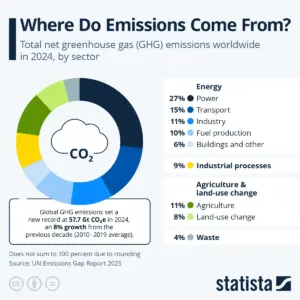
That said, by 2024, China, the United States and India remained the top three emitters, collectively contributing to over half of global CO₂ emissions which continue to rise.
Since 2005, China has held the position as the world’s largest carbon emitter. In 2024, the country emitted 12.6 gigatons of CO₂, about one-third of total global emissions.
The US retreats
The United States emitted 4.5 gigatons of CO₂ in 2024, making it the second-largest emitter globally and the largest per capita. The previous administration under President Biden enacted the Inflation Reduction Act, committing to halving emissions by 2030 and reaching net-zero by 2050. At the time the US also pledged to cut emissions by between 61 percent and 66 percent below 2005 levels by 2035 and signed the Glasgow Leaders’ Declaration.
However, the current administration under President Trump has reversed many of these commitments. Trump’s administration has declared war on wind and solar development, and cheap Chinese solar panels face formidable trade barriers. US coal consumption is rising this year after a long decline.
The US has exited the Paris Agreement and reopened the Arctic National Wildlife Refuge to oil and gas exploration, raising concerns over the country’s long-term climate credibility.
India active
India became the third-largest emitter in 2023, surpassing the European Union. In 2024, India’s CO₂ emissions reached three gigatons.
Despite its growing emissions, India is rapidly expanding its renewable energy sector. As of October 2024, 46.3 percent of its electricity came from renewable sources.
Under its enhanced Nationally Determined Contributions, India plans to reduce emissions intensity by 45 percent by 2030 and generate 50 percent of its electricity from non-fossil fuels by the same date. It hopes to reach net-zero emissions by 2070.
India also aims to increase forest cover from 25 percent to 33 percent and restore 26 million hectares of degraded land to establish an additional carbon sink of 2.5 to 3 billion tonnes of CO₂ equivalent.
That change in motivation may be the most important breakthrough of all, ensuring that this year’s inflection points are just the beginning.